Disclaimer: This article is for informational purposes only and does not constitute financial advice. BitPinas has no commercial relationship with any mentioned entity unless otherwise stated.
📬 Get the biggest crypto stories in the Philippines and Southeast Asia every week — subscribe to the BitPinas Newsletter.
Nagkaroon na ba ng holdapan sa kanto ninyo? (Has there been a robbery on your street corner?)
The term “holdap” is a Filipino staple derived from the English “hold up.” It refers to a situation where someone is threatened into giving up their valuables to a “holdaper.”
For years, this kind of robbery victimized people walking on dimly lit streets. But today, the landscape has changed. Holdapers can now be selective about who they target… and that list includes crypto investors like you.
This is called a wrench attack.
What is a wrench attack?

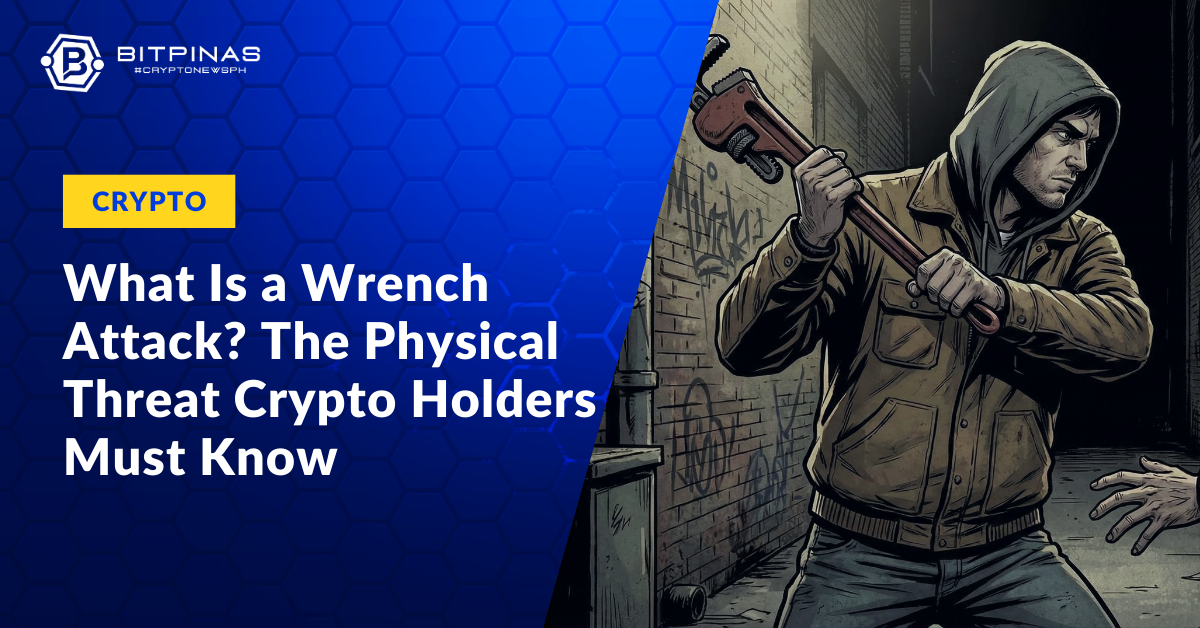
While cryptocurrencies are built on sophisticated blockchain technology, a wrench attack is a decidedly low-tech threat. Instead of hacking a crypto wallet or a device, criminals use physical force, such as threats, violence, or torture, to coerce the victim into revealing their seed phrase, password, or PIN.
The term originated from a 2005 xkcd webcomic, which jokingly illustrated that an attacker hitting someone with a $5 wrench is a far more effective password-cracking method than a complex computer script.
The scary reality is that criminals often prefer this method. Instead of spending months developing malware to hack a system, they simply scare the owner into handing over the keys.
And the target victim could be you.
Wrench attacks are unfortunately common in the crypto industry.
A tragic example occurred in late 2025 involving Roman Novak, a Russian crypto millionaire. He and his wife were murdered after failing to comply with a ransom demand for their digital assets. Their bodies were found in a desert near Dubai, and investigations revealed they were tortured prior to their deaths.
This serves as a grim reminder: Wrench attacks target those who own crypto… specifically those who publicly share their holdings.
The Filipino Context: The Dangers of “Flexing”
In the Philippines, many scams and crimes begin on social media. It is common to see posts featuring screenshots of massive trading gains or luxury purchases.
While you should be proud of your hard work, bear in mind that flaunting wealth online attracts criminals.
The Bangko Sentral ng Pilipinas (BSP) has even warned that displaying wealth on social media makes you a magnet for scammers. Furthermore, simple public identifiers, like wearing crypto-branded shirts, caps, or discussing profits in public places, can mark you as “the crypto guy.”
In today’s era, holdapers are strategic. It is much easier for them to victimize someone they already know holds digital assets.
So, what can you do?
The safest strategy sounds obvious, but it is often ignored: Keep your crypto holdings private.
1. Behavioral Safety
- Don’t Flex: Avoid posting specific gains or wallet balances.
- Stay Low Profile: Blend in with the community. Use an NFT or avatar as a profile picture rather than your real face if you are active in crypto discussions.
- Share Experience, Not Wealth: Focus on sharing your knowledge and journey rather than your net worth.
2. Technical Safety
It is time to utilize technology to make wrench attacks nearly impossible, or at least useless to the thief:
- Multi-Sig Wallets: Use wallets that require multiple private keys to approve a transaction.
- Time-Locks: Consider wallets that enforce a delay (e.g., 24 hours) before funds can be moved. Even if you are threatened, you cannot move the funds immediately.
Overall: Safety First
Life is infinitely more valuable than coins.
Knock on wood, but if a wrench attack happens to you, prioritize your safety over your assets. No matter how much money is at stake, your life comes first.
Your crypto wealth can possibly be recovered or earned again. Your life cannot.
The Golden Rule: Do not flex what you have; flex the fruits of your labor quietly. And if the worst happens and your password is stolen, prioritize your survival and report it to the authorities immediately.
This article is published on BitPinas: What Is a Wrench Attack? The Physical Threat Crypto Holders Must Know
What else is happening in Crypto Philippines and beyond?
