
Key Takeaways
- Cardano CEO Frederik Gregaard stated that blockchain must provide a neutral alternative to politicized global banks.
- Showing impact, the A7A5 stablecoin moved $93B before the EU banned it in a November 2025 sanctions package.
- Moving past speculation, Gregaard notes blockchain should next build a resilient infrastructure for commerce.
Cardano Foundation CEO Talks Blockchain as a Neutral Settlement Layer
While blockchain technology is taking its first steps in the formal financial system, some believe that its mission is to become a key element for the next truly independent settlement layer.
Frederik Gregaard, CEO of the Cardano Foundation, reflected on the alternative role that blockchain must follow as the current banking system has been politicized and shown to be dependent on geopolitical conflicts.
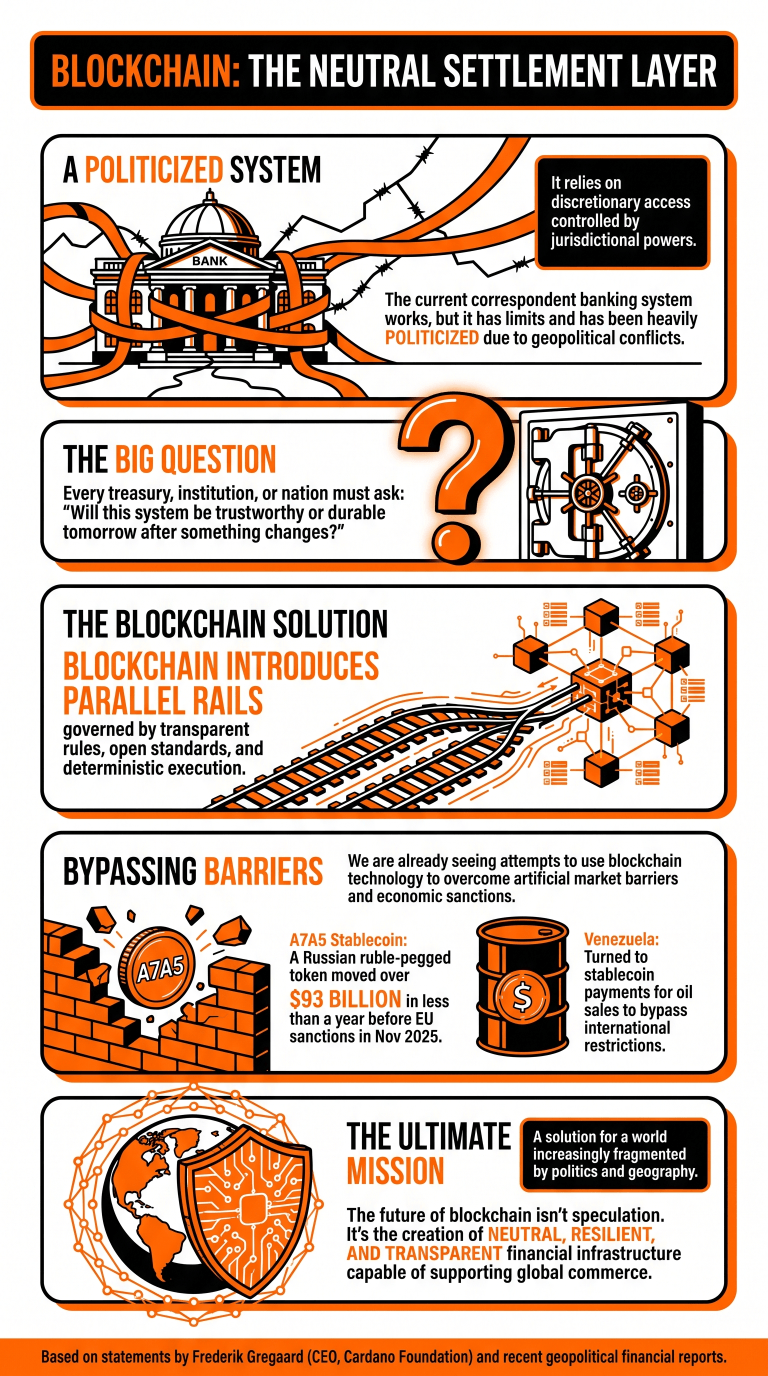
Gregaard assessed that while the correspondent banking system, which has served as the standard for international settlements, works, it has limits and must obey the powers that exert control over its jurisdictions.
As a result, he stated that every treasury, institution, or nation must ask not only whether this system is compliant today, but whether it will be trustworthy or durable tomorrow after something changes.
For Gregaard, this is a use case that will allow blockchain infrastructure to shine, as “it introduces parallel rails governed by transparent rules, open standards, and deterministic execution rather than discretionary access.”
In this sense, we have already seen several attempts to use blockchain technology to overcome artificial market barriers, including economic sanctions.
A meaningful example is the establishment of a financial network around A7A5, a Russian ruble-pegged stablecoin. The token that moved over $93 billion in less than a year before the European Union forbade its use in its 19th package of sanctions issued in November 2025.
Reports indicated that Venezuela, which was affected by similar restrictions not so long ago, had turned to stablecoin payments for oil sales.
Gregaard concluded that, rather than speculation, the future of blockchain tech was in “the creation of neutral, resilient, and transparent financial infrastructure capable of supporting global commerce when traditional systems become increasingly fragmented by politics and geography.”
