Zama, the company that has spent years quietly building fully homomorphic encryption tools for blockchains, just bought TokenOps, a token distribution platform. The goal: let institutions run vesting schedules, airdrops, and payroll entirely encrypted, without giving up the transparency guarantees that make blockchains useful in the first place.
Every time a project distributes tokens today, the entire vesting schedule, wallet allocations, and unlock timelines are visible on-chain for anyone to see. For retail projects, that’s a feature. For institutional issuers managing cap tables, compensation, and strategic token allocations, it’s a dealbreaker.
What FHE actually does here
Fully homomorphic encryption, or FHE, allows computations to be performed on encrypted data without ever decrypting it. A smart contract can process your token vesting schedule, verify everything checks out, and execute distributions, all while the underlying data remains completely private.
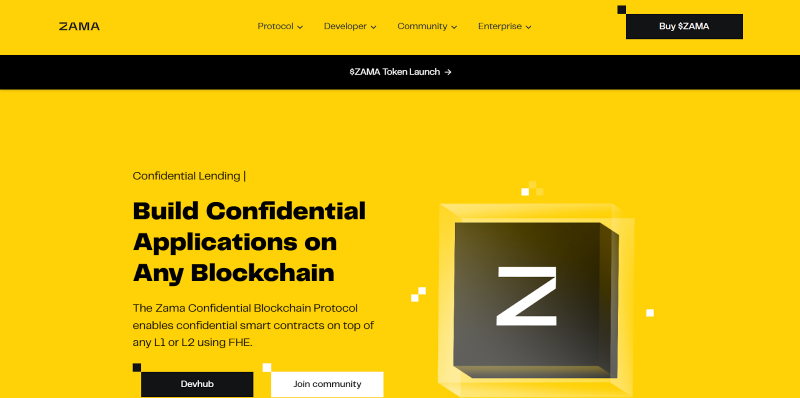
Zama has been building FHE tooling through what it calls the Zama Confidential Blockchain Protocol, designed as a confidentiality layer for major networks like Ethereum and Solana. TokenOps was already built on top of Zama’s FHE technology as a non-custodial token distribution platform, so the acquisition is less of a pivot and more of a consolidation. Zama is pulling the product team in-house rather than maintaining an arm’s-length relationship.
TokenOps handles private vesting schedules, encrypted payroll distributions, and airdrop mechanics where recipients and amounts stay hidden until execution.
A well-funded encryption bet
Zama has raised over $150M in total funding, including a $57M Series B round that valued the company above $1B.
The company acquired KKRT Labs to bolster its zero-knowledge capabilities, with a stated target of processing over 10,000 confidential transactions per second.
Zama is also planning a mainnet launch that will feature a sealed-bid Dutch auction selling 10% of its $ZAMA token supply. The auction itself will showcase Zama’s encryption technology, with bids remaining private until the auction resolves.
Why institutions care about on-chain privacy
When a company issues tokens to employees, investors, or partners, those distributions are immediately visible to the entire world. Compensation structures, investor allocations, strategic partnerships: all on display. Traditional finance doesn’t work this way.
Zama’s bet is that FHE-encrypted token distributions solve this problem without requiring institutions to retreat to private databases or centralized platforms. The tokens still live on public blockchains. The smart contracts are still auditable. But the specific data, who gets what and when, stays encrypted.
This positions Zama in a different lane than privacy-focused Layer 1 chains like Secret Network or Aleo. Rather than building an entirely new blockchain that few institutions will migrate to, Zama is adding a confidentiality layer on top of chains that institutions already use or are evaluating.
