
Bitcoin has fallen back toward $65,000 after renewed tensions involving Israel and Lebanon tempered optimism surrounding a potential U.S.-Iran agreement, while traders also reduced risk ahead of the Federal Reserve’s policy decision.
Summary
- Bitcoin fell from $66.9K to $65.4K as renewed Israel-Lebanon tensions dented optimism around a potential U.S.-Iran agreement.
- Technical indicators remain cautiously bullish, with BTC holding above a rising trendline and key support near $64K-$65K.
- Traders are closely watching the Fed decision, while liquidation clusters around $65K and $67K-$68.5K could drive the next major move.
According to crypto.news market data, Bitcoin (BTC) price dropped from an intraday high near $66,900 on June 16 to a low around $65,400 before stabilizing near $65,700 at press time.
Bitcoin price retreated following reports that Iran’s military accused Israel of violating the ceasefire in southern Lebanon dozens of times since the U.S.-Iran deal was announced, warning of a “harsh response” if attacks continue.
The decline interrupted a rally that had gained momentum earlier in the session after reports suggested Washington and Tehran were preparing to sign a memorandum of understanding later this week. The agreement would reportedly allow tanker traffic through the Strait of Hormuz, a development that helped push crude oil prices down more than 6% to roughly $75.5 per barrel, their lowest level since early March.
Alongside the geopolitical headlines, traders remained focused on the Federal Reserve’s two-day policy meeting. Markets widely expect rates to remain unchanged, but uncertainty surrounding Fed Chair Kevin Warsh’s outlook has limited risk appetite after inflation accelerated to 4.2% year-over-year in the latest CPI report.
Bitcoin faces resistance near major technical inflection point
On the daily chart, Bitcoin is attempting to reclaim a key horizontal level near $65,150 that served as support throughout February and March before breaking during the early June sell-off. Bulls briefly pushed above that zone, but sellers emerged near $67,000 and forced a pullback.
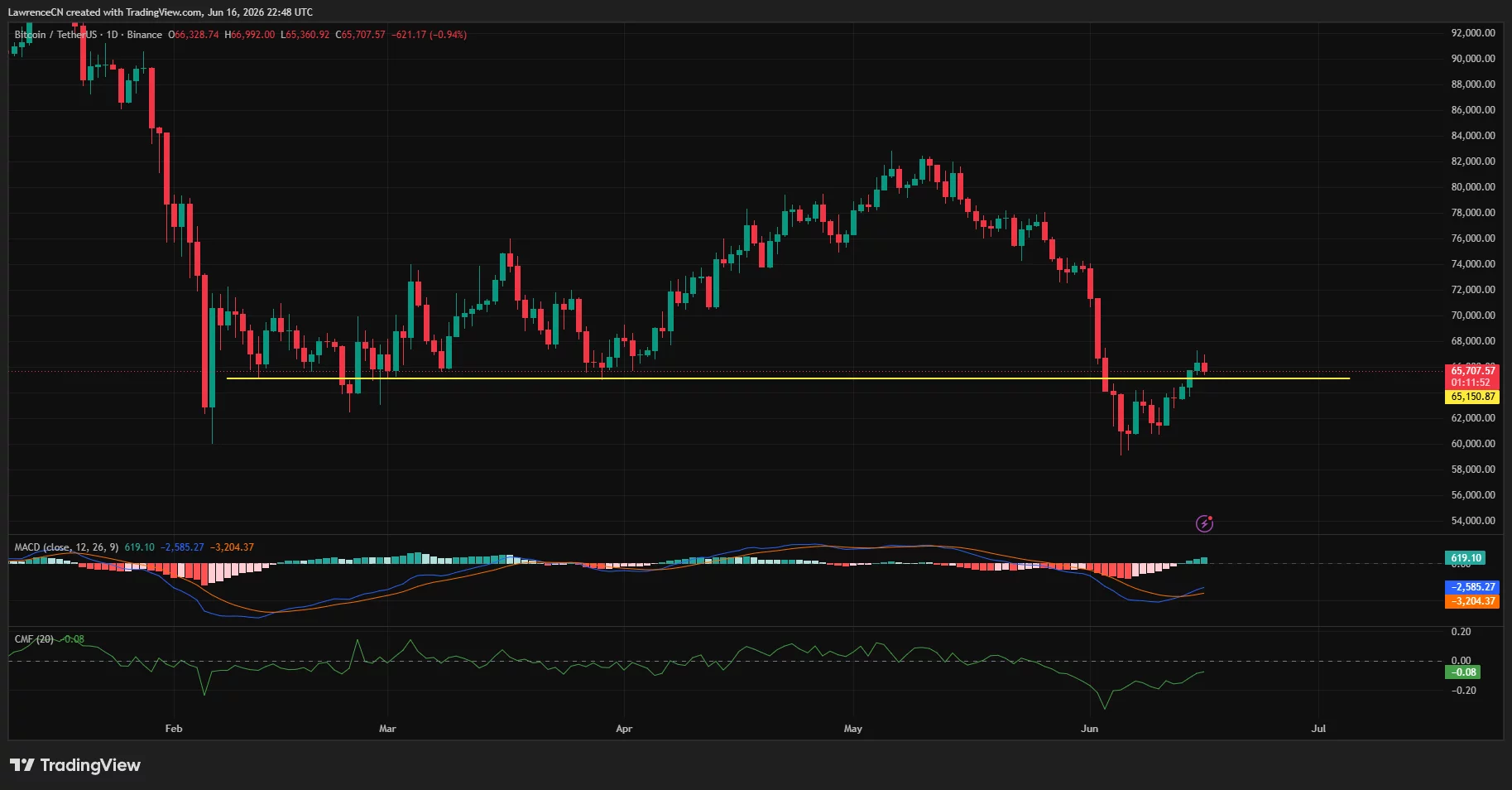
The recovery has nevertheless improved the short-term technical structure. On the four-hour chart, Bitcoin remains above a rising trendline drawn from the June 6 low near $59,200. The move has also carried the asset above the descending trendline that capped prices throughout late May and early June.
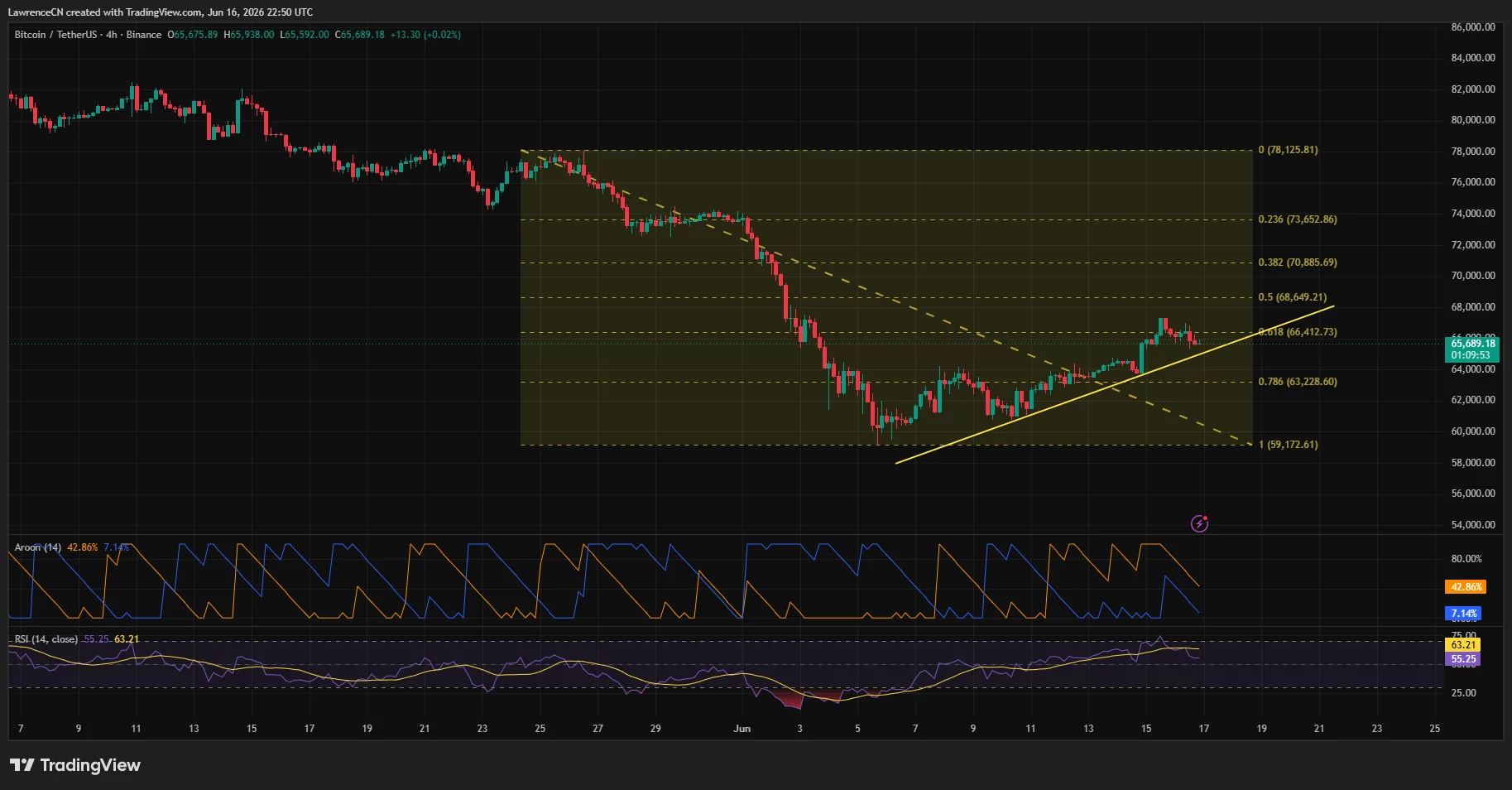
Fibonacci retracement levels place immediate resistance near $66,400, corresponding to the 61.8% retracement of the decline from roughly $78,100 to $59,200. A successful breakout could expose the 50% retracement level around $68,650, followed by resistance near $70,900.
Momentum indicators remain constructive despite the latest pullback. The four-hour RSI held above 55 while the Aroon Up indicator remained dominant over the Aroon Down reading, suggesting buyers still retain near-term control. On the daily timeframe, the MACD histogram has turned positive for the first time since the June breakdown, although Chaikin Money Flow remains slightly below zero, showing capital inflows have yet to fully recover.
Commenting on the market structure, crypto analyst Ardi noted that Bitcoin’s ability to defend the $64,000 region remains critical ahead of the Fed meeting.
“If price holds that level, then even with a typical post-FOMC correction, bulls can keep the local structure with a chance to extend the rally.”
Additional support comes from longer-term moving averages. According to crypto analyst Daan Crypto Trades, Bitcoin is currently trading between its weekly 200-day moving average and 200-day exponential moving average.
“Bulls want to close the weekly candle back above the 200EMA while holding the 200MA as support.”
Fed decision and geopolitical risks threaten Bitcoin recovery
CoinGlass liquidation data shows one of the largest nearby liquidity pools sits around $65,000, where leveraged long positions have accumulated over the past 24 hours. A break below that area could expose another concentration of liquidation interest near $64,500 and potentially accelerate downside volatility.
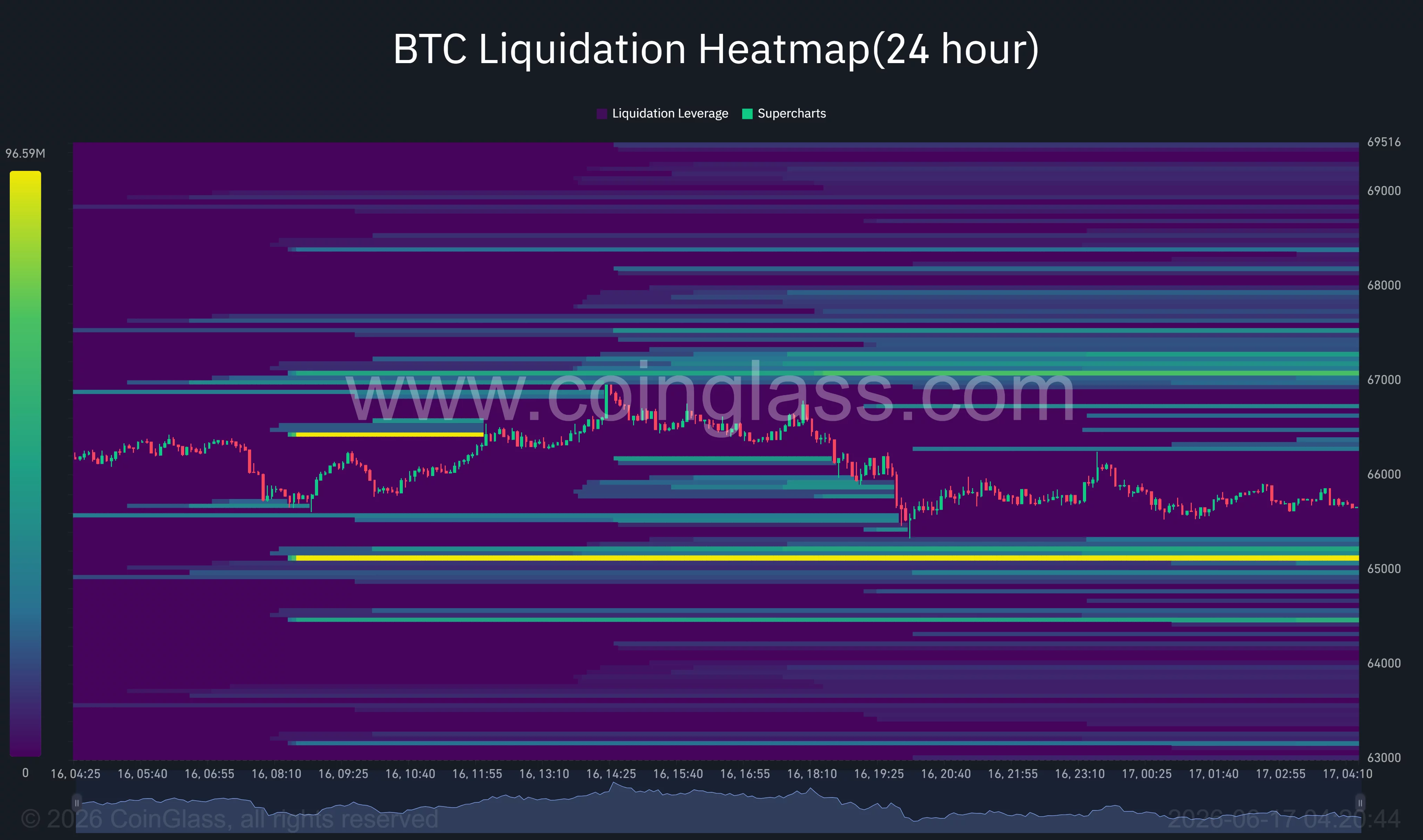
Meanwhile, substantial short liquidation clusters remain stacked between $67,000 and $68,500. Those levels could act as upside magnets if Bitcoin regains momentum following the Fed decision.
Geopolitical developments remain another source of risk. Israeli Prime Minister Benjamin Netanyahu has stated that Israeli forces will continue occupying southern Lebanon despite the U.S.-Iran agreement, while Iran has threatened retaliation if alleged ceasefire violations persist.
Any deterioration in regional stability could quickly reverse the market’s recent optimism surrounding the Strait of Hormuz and energy supplies.
Failure to hold the $64,000-$65,000 support zone would weaken the current recovery structure and shift attention back toward the June low near $59,200. Conversely, a break above $66,400 could open the door to a move toward $68,600 and potentially $71,000 as traders unwind short positions after the FOMC meeting.
Disclosure: This article does not represent investment advice. The content and materials featured on this page are for educational purposes only.
