Key Takeaways
- Singapore’s measured crypto activity grew 55.4% year over year.
- Institutional-platform activity climbed 94% to $60 billion.
- Three Southeast Asian markets handled 14.4% of global small-value transfers.
Singapore Records $60 Billion in Institutional Crypto Activity
Crypto trading and financial services expanded in Singapore even as activity declined across Central and Southeast Asia and Oceania. Blockchain analytics company Chainalysis detailed Singapore’s $284 billion in crypto activity in a Sept. 30 analysis covering July 1, 2025, through June 30. The country recorded the region’s largest measured crypto economy, up 55.4% year over year.
Institutional-platform business rose 94% to $60 billion, with much of it concentrated among market makers, which provide trading liquidity, over-the-counter firms, which negotiate transactions privately, and institutional brokerages. Daniel Yang, head of compliance at Singapore-based trading firm QCP Group, described the broader shift:
“The narrative has broadened beyond trading returns to include payments, treasury management, and market infrastructure.”
Treasury management involves managing an organization’s cash, funding, and financial risks.
Growth also extended to exchanges, with flows into centralized platforms operated by intermediaries increasing 30% and decentralized venues using blockchain-based trading protocols advancing 69%. Institutional expansion outpaced the 19% increase across the rest of the region and 15% elsewhere globally. The financial center also remained a net recipient of cross-border crypto transfers, with cumulative net inflows reaching approximately $5 billion by midyear.
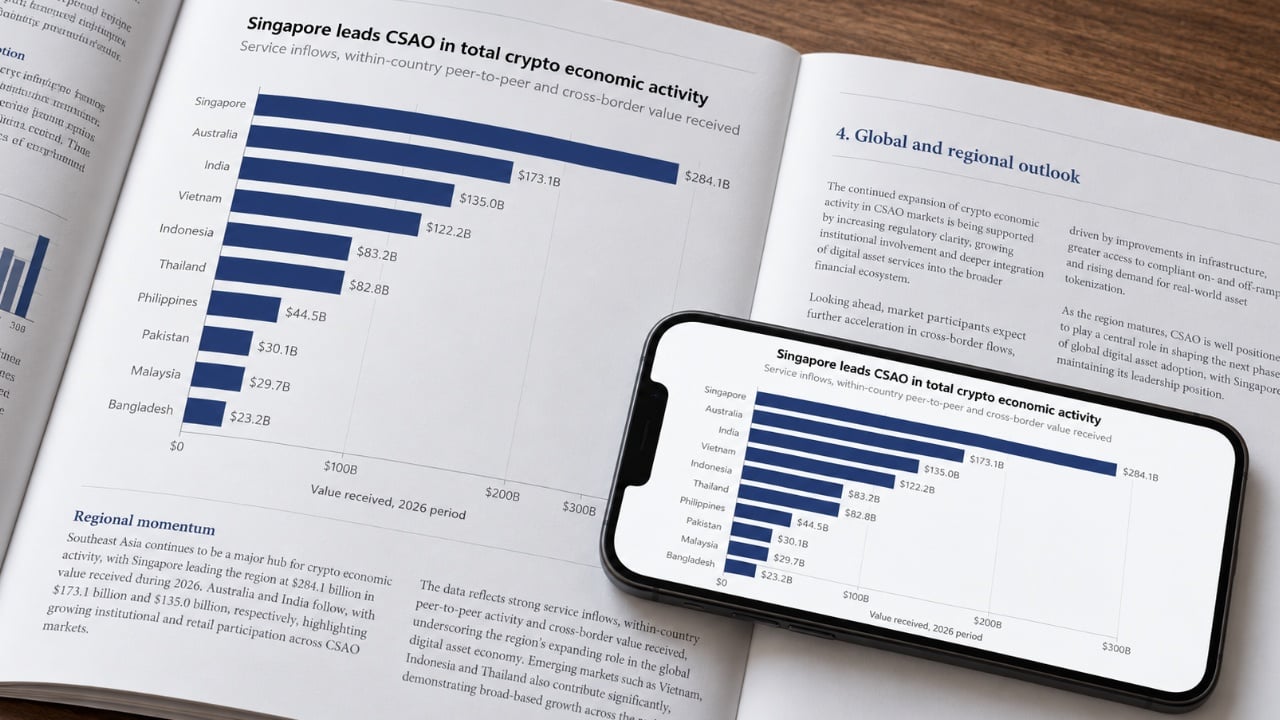
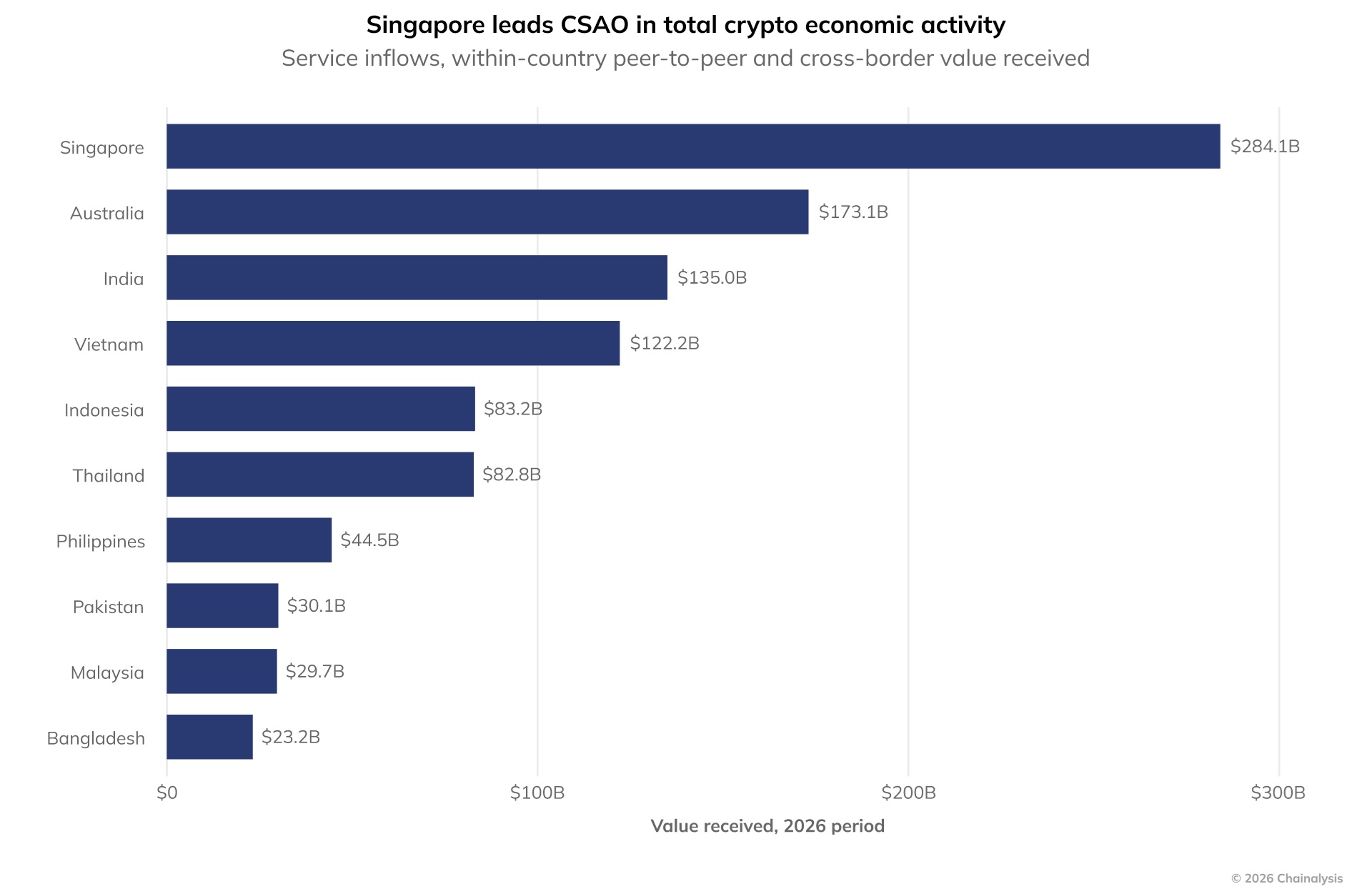
Singapore’s lead extended beyond institutional trading to the broader regional comparison shown in Chainalysis’ chart. The measure combines value received through services, transfers between individuals within countries, and cross-border inflows during the reporting period. Singapore’s total was approximately $111 billion above Australia’s, while Vietnam ranked fourth at $122.2 billion, followed by Indonesia at $83.2 billion and Thailand at $82.8 billion.
Stablecoins Connect Crypto Growth With Cross-Border Payments
Cross-border stablecoin activity exceeded domestic activity in every regional market examined, with the overall value ratio reaching 3.2 to 1. Stablecoins are designed to track a reference asset, typically a national currency. Their payment applications sit alongside trading uses, while established domestic systems can reduce demand for alternative ways to transfer money locally.
Smaller transfers between individuals showed a distinct adoption pattern in the Philippines, Thailand, and Vietnam during the same period. Together, they registered 5.4 million transactions under $10,000, accounting for 14.4% of the global total despite representing just 2.5% of worldwide crypto activity. More than four in five domestic transfers in those countries were below $1,000.
Singapore-based businesses also attracted capital during the reporting period as investors backed infrastructure connecting digital assets with traditional currencies. Tazapay’s Series B financing reached $36 million following a March extension led by Circle Ventures. The company’s settlement technology connects stablecoins with local fiat currencies, or government-issued money, across international markets.
Investment continued after the measurement period, with Japanese financial conglomerate SBI Holdings Inc. (Tokyo: 8473) announcing a Dtcpay investment Sept. 18. Singapore-based Dtcpay’s completed Series A totaled $25 million. Its technology exchanges and settles digital tokens and fiat currencies, while the funding supports merchant expansion, technical development, and new business and consumer features.
Singapore Advances Stablecoin Rules as Crypto Licensing Expands
The wider regional economy contracted 6.8%, though institutional platforms processed $152.3 billion, up 40% year over year. Australia remained second-largest at $173.1 billion despite a 5.6% decline; its institutional business increased 33.3% to $39.92 billion. India ranked third at $135 billion and led centralized exchange inflows with $88.4 billion, compared with $82.3 billion for Singapore.
Regulated market access expanded after June as exchanges continued developing local operations serving both individual and institutional customers. Gemini secured a Major Payment Institution license, announced Sept. 8, covering digital payment token and cross-border money transfer services. The exchange provides spot trading, or direct asset purchases and sales, custody, meaning asset safekeeping, and over-the-counter services in the country, where it has operated since 2020.
Stablecoin regulation is also advancing through proposed legislation addressing issuer qualifications, financial safeguards, and consumer protection requirements. The Monetary Authority of Singapore opened its stablecoin legislative consultation Sept. 1. Proposals include prohibiting interest payments on MAS-regulated tokens, requiring stress tests, and establishing recovery and orderly wind-down plans. Comments are due Oct. 16.
