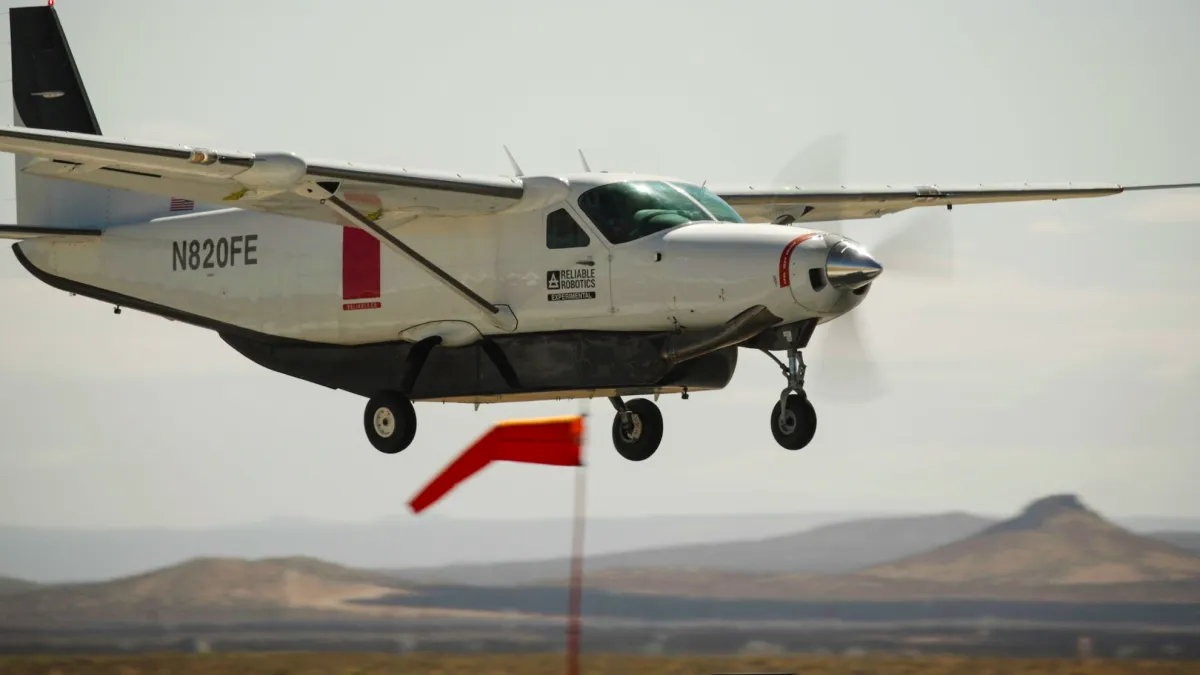
Reliable Robotics has been working for nearly a decade to commercialize autonomous flying technology that can be installed on existing aircraft. Now, with a $115 million funding boost, the Mountain View, California-based startup has a longer runway as it pushes to get its autonomous flight system certified by the Federal Aviation Administration — a critical milestone that co-founder and CEO Robert Rose said the startup is inching toward.
The financing is an extension of its Series D round and includes $90 million in equity funding led by Nimble Partners and $25 million in debt from Silicon Valley Bank. The Series D round, which now totals $275 million, has pushed the startup’s valuation beyond the $1 billion mark. Other investors include Gideon Strategic Partners, RockCreek, Geek Ventures, Gold Hill Capital, Sparkwave Capital and others. Reliable has raised $380 million to date.
“We continue to make steady progress and deliver evidence to the FAA and every day, we inch closer and closer,” said Rose, a former director of flight software at SpaceX who has also had stints at Tesla and Google. Reliable co-founder and CTO Juerg Frefel is also a SpaceX veteran who spent nearly a decade there as an engineer.
And in aviation — one of the most regulated industries in the world — moving toward certification of new technology is progress.
Reliable Robotics is working to gain FAA certification on four fronts, all of which are linked to its goal of autonomous flight.
Its first product, called continuous autopilot engagement, handles the engine startup, taxiing, takeoff, and landing for the pilot, who remains in the aircraft and interacts with the autonomous flight system through a touchscreen. Rose expects to receive certification for this critical first system in 18 to 24 months.
The second certification, which Rose says is at least three years away, removes the pilot from the cockpit and moves them to a ground-control station.
Reliable is also working toward certification of a collision-avoidance radar, which the company has developed in-house after failing to attract legacy suppliers to take on the project. Most conventional radar systems use an antenna that moves to scan the surrounding airspace. Reliable has developed a solid-state radar that has no moving parts and scans the sky at a longer range and at much higher resolution, according to Rose. It’s also easier to maintain because there are no moving parts and it costs less, he added.
“This is of great interest to operators these days, given the collisions that we’ve had recently in commercial aviation,” he said, adding that the radar also works on the ground to prevent collisions with other aircraft or infrastructure. Rose expects the solid-state radar to be certified by the end of 2027.
The final certification is for its airline, called Reliable Airlines, which will be the first airline certified to use the autonomous flying technology. The airline is based in Albuquerque and uses six Cessna Caravans — workhorses of the aviation industry — to fly cargo six days a week. (The FAA certifies equipment, but the agency also must certify the airline operations under a separate set of regulations.)
While the certification process is lengthy, Nimble Partners founder John Burbank said the benefits will be broad and significant.
“It’s a much bigger effort and much bigger opportunity than to just build one plane,” Burbank said, noting that Reliable is building a system that can be adopted by any airframe. “They had a really big vision nine years ago, and saw this as something needed and essential. Once they get the first one approved, then everyone will realize this is going to be the path for the industry, just as we’re seeing the path for the auto industry being autonomous.”
When you purchase through links in our articles, we may earn a small commission. This doesn’t affect our editorial independence.
