Hyperliquid is gaining attention in the decentralized trading space for combining some of the best features of centralized exchanges with decentralization. As more traders seek transparent, non-custodial trading, Hyperliquid meets this need by using an on-chain order book and a custom-built blockchain designed for high-speed trading.
This allows users to trade perpetual contracts and spot assets while keeping ownership of their funds. In this article, we will explain how Hyperliquid works, its key features, and how it compares with other decentralized exchanges (DEXs).
What Is Hyperliquid?
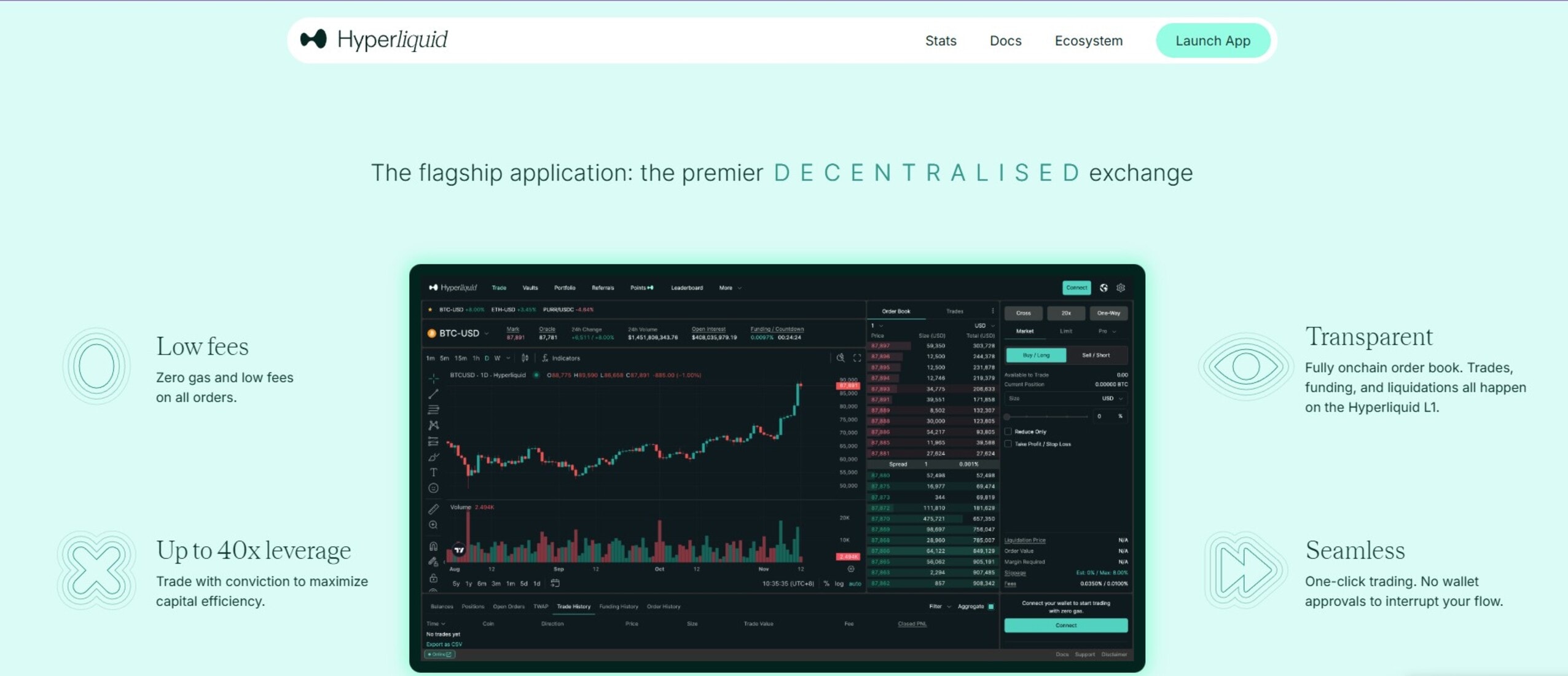
Hyperliquid is a decentralized trading platform designed to offer fast, efficient, and transparent crypto trading. Unlike many leading decentralized exchange platforms that rely on automated market makers, Hyperliquid uses an on-chain order book, enabling traders to place limit and market orders and implement advanced trading strategies.
Hyperliquid runs on its own custom blockchain built specifically for trading applications. This blockchain is optimized for high-speed transactions, low latency, and real-time settlement, allowing users to execute trades quickly while keeping their assets secure in their own wallets. Hyperliquid supports both spot and perpetual futures trading, giving users multiple ways to participate in the market.

Who Created Hyperliquid?
Hyperliquid was founded by Jeff Yan, a former Wall Street trader and key figure from Chameleon Trading, together with a team of experienced derivatives traders from top financial firms. Their combined expertise in high-frequency trading highlighted major gaps in existing decentralized exchanges, including slow execution and limited tools for serious users.
Using this experience, the Hyperliquid team designed a purpose-built Layer-1 blockchain with a decentralized exchange that prioritizes speed, precision, and efficiency. Features such as sub-millisecond order matching, advanced order types, and Hyperliquidity Provider (HLP) vaults reflect a focus on derivatives trading, as seen in major global crypto trading platforms and market-making automation.
How Does Hyperliquid Work?
The Hyperliquid ecosystem combines a custom Layer-1 blockchain, HyperCore, with an off-chain matching engine, delivering centralized-exchange speed while keeping settlement fully on-chain. User orders go to the current validator leader via HyperBFT, who bundles transactions into blocks, broadcasts them for validator votes, and achieves finality after a few rounds with quorum from two-thirds of staked validators.
This process ensures that trades are confirmed quickly and securely. The system follows a leader-based design inspired by HotStuff and uses optimistic execution, allowing blocks to be processed as quickly as network conditions permit, often in under 0.07 seconds.
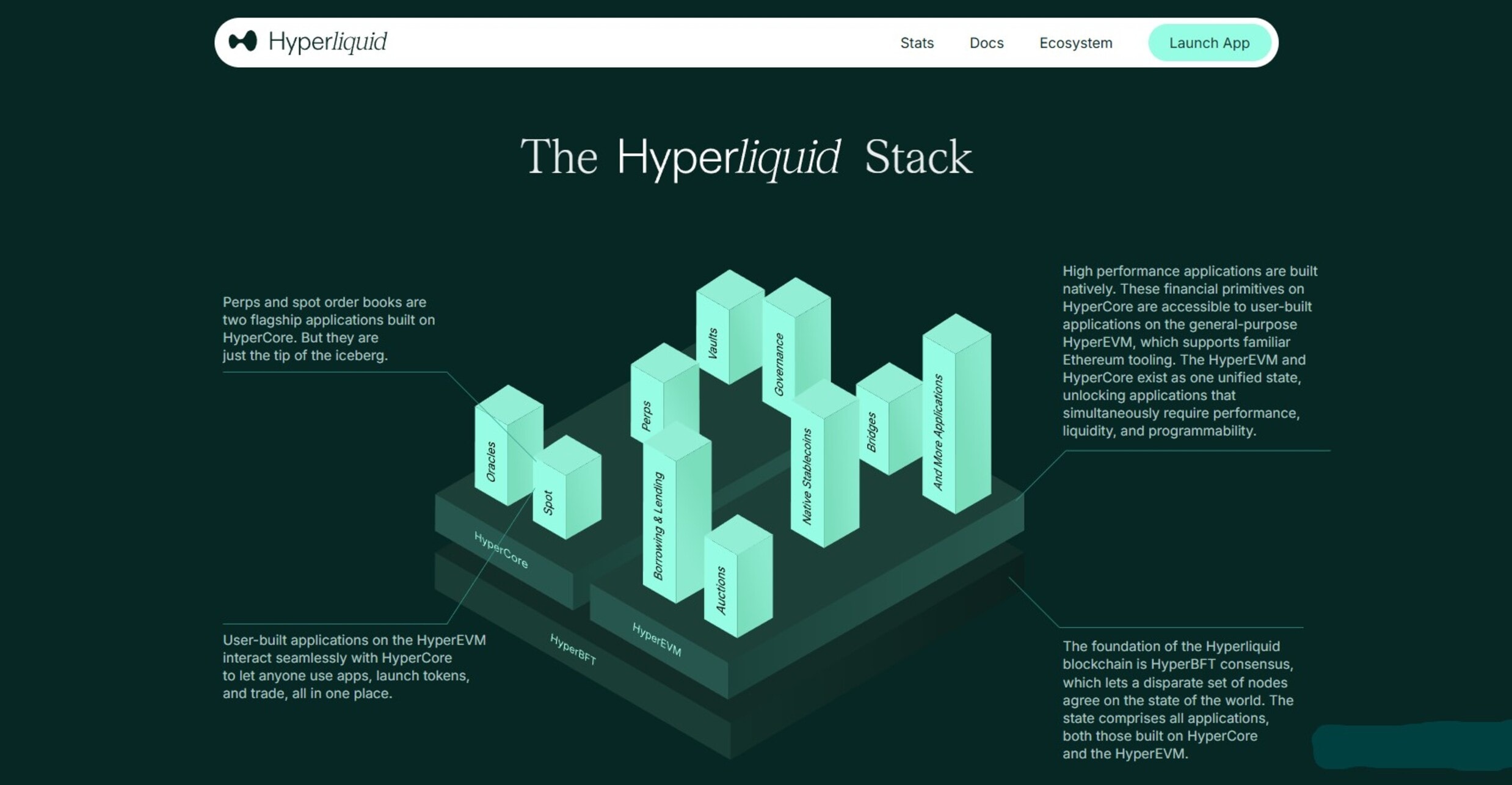
HyperCore handles the core state for margin accounts, order matching, and liquidations without relying on external order books. Meanwhile, HyperEVM provides EVM compatibility for general decentralized applications, but all trading operations remain optimized within HyperCore to minimize latency.
After matching, all trades settle transparently on-chain, reducing risks such as front-running or manipulation that can occur in purely off-chain systems. The architecture supports up to 200,000 orders per second, making Hyperliquid suitable for both professional and high-frequency trading strategies.
Hyperliquid Ecosystem and Tokens
Hyperliquid has a native token called HYPE, which forms the core of its ecosystem. The HYPE token powers governance, allowing users to participate in decisions that shape the platform’s development, and also supports rewards, staking, and other incentives that encourage active participation.
By integrating HYPE into trading, liquidity provision, and platform governance, Hyperliquid ensures that all users have a role in maintaining network security, contributing to liquidity, and benefiting from the platform’s growth.
What is the HYPE token?
HYPE is the native utility and governance token of the Hyperliquid Layer-1 blockchain. It was launched through a community airdrop in late 2024, rewarding early traders and users. The token has a fixed supply of 1 billion, and a portion of trading fees is used to repurchase and burn HYPE, creating scarcity and supporting its long-term value.
HYPE serves multiple critical functions. It acts as a gas token for HyperEVM transactions and trading fees, and offers staking to secure the HyperBFT consensus. It is also used as a reward for validators and enables governance through on-chain voting on upgrades, listings, and treasury decisions.
Stakers and Hyperliquidity Provider vault users can earn yields often exceeding 20–50% APY, while HYPE also provides access to premium copy-trading vaults and functions as collateral in spot and perpetual markets.
Token Utility and Governance
The HYPE token powers multiple functions across the Hyperliquid ecosystem while giving users a voice in governance. It acts as the gas token for HyperCore and HyperEVM transactions, often under $0.01 per trade. HYPE also serves as collateral for spot and perpetual positions, enabling leveraged trading without bridging external assets.
Governance is managed through on-chain voting on Hyperliquid Improvement Proposals, or HIPs, allowing staked token holders to approve updates, new trading pairs, vault strategies, and treasury decisions. Additionally, quadratic voting prevents dominance by large holders, and approved changes, such as HyperBFT or HyperEVM upgrades, are implemented rapidly.
Staking and Rewards
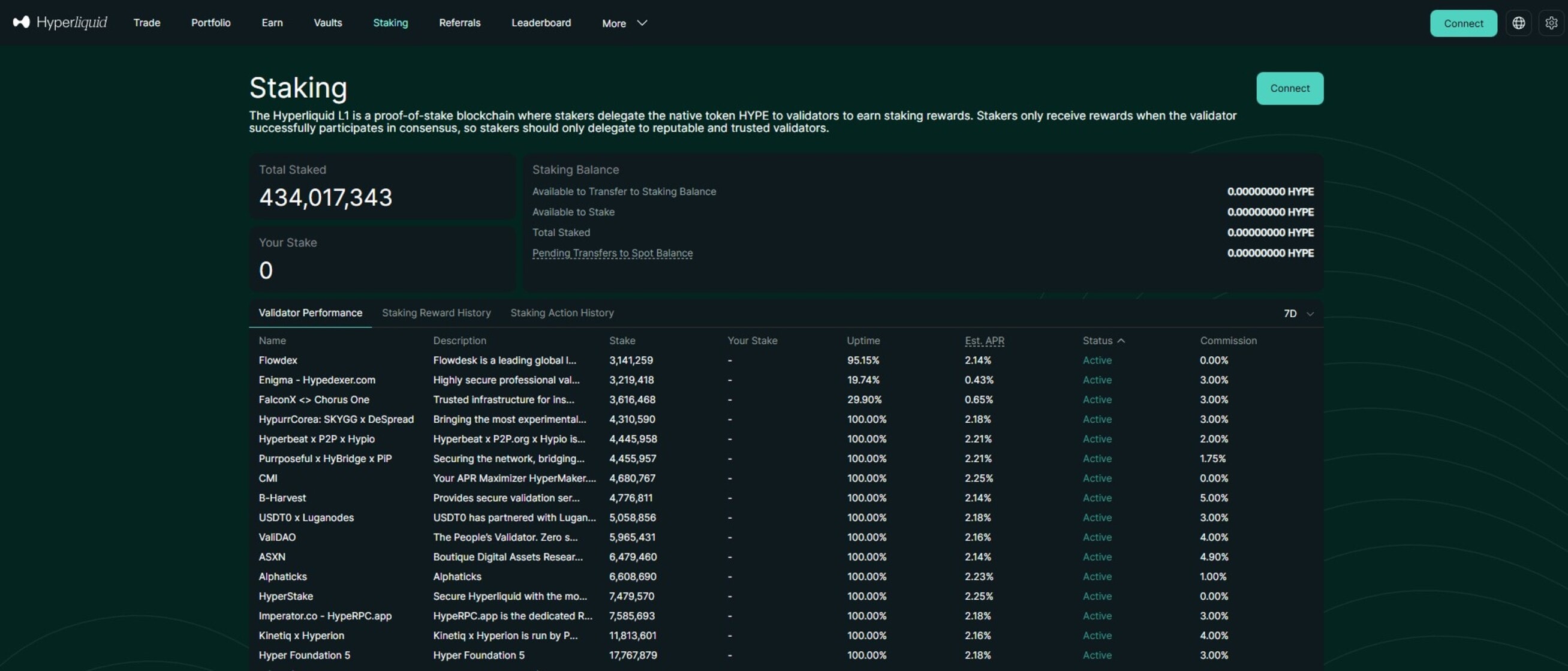
Staking HYPE tokens on Hyperliquid secures the HyperBFT consensus while providing passive income. Users delegate HYPE to active validators from a dedicated account, with a minimum self-delegation of 10,000 HYPE.
Rewards come from the future emissions reserve rather than inflation and accrue every minute during 100k-round epochs, with daily distribution and automatic compounding, allowing stakes to grow without manual claiming. The dynamic reward system adjusts based on total staked HYPE. For example, 400M HYPE staked yields around 2.37% APY, while 142–144M HYPE staked produces 2.27 – 2.29%.
Validators earn block rewards and share proportional returns with delegators, after a 5–10% commission. Stakers also gain trading fee discounts from 5% up to 40% and eligibility for airdrops and vault bonuses. To learn more about how staking works and its benefits, read our detailed guide on what staking is in crypto.
Key Features of Hyperliquid
1. Hyperliquid Exchange
Hyperliquid Exchange offers traders a fast, reliable, and flexible platform for managing their crypto positions. It is designed to handle high-frequency trades without delays, ensuring that every order is executed accurately and transparently. Both beginners and professional traders can use the platform, whether they want to trade casually or implement advanced strategies.
The exchange also includes tools and features that give users more control over timing, pricing, and execution. Below are the three main features of the platform, which are perpetual futures, the spot market, and advanced order types.
Perpetual Futures
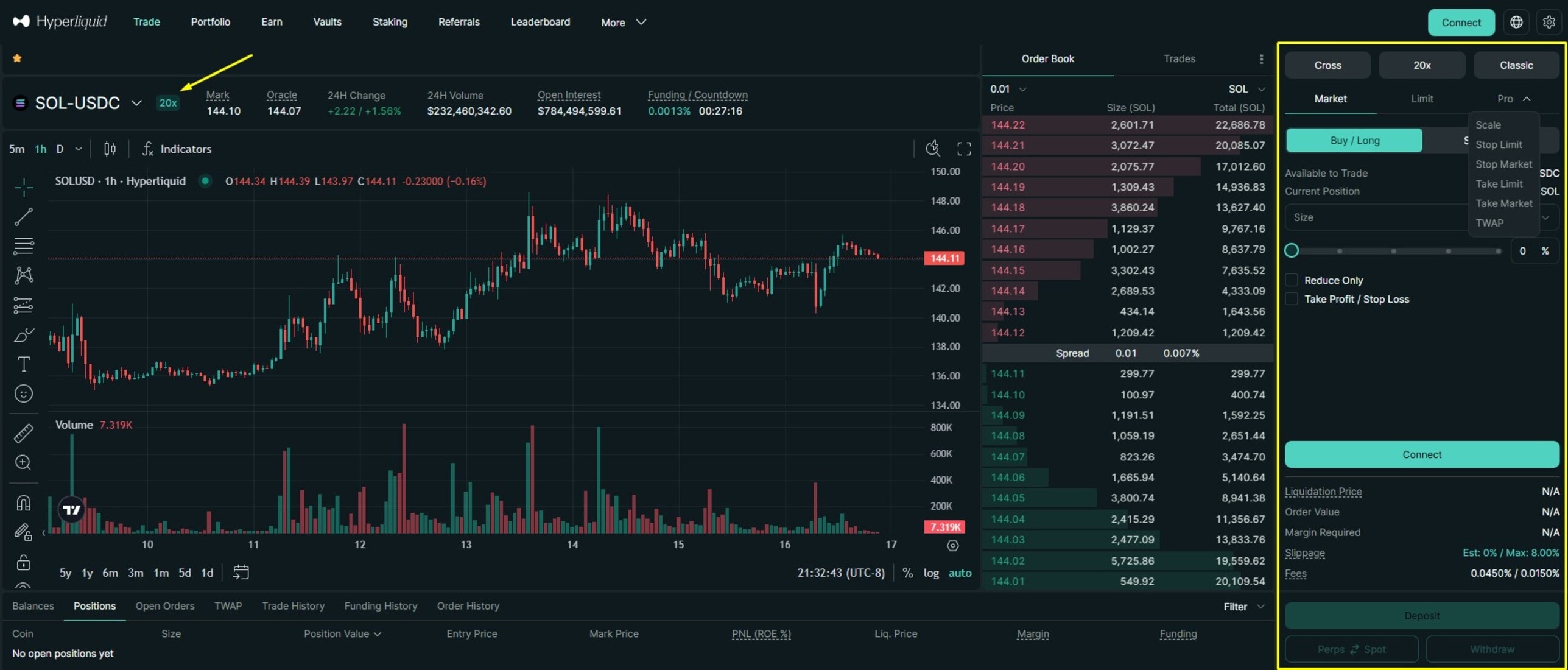
Perpetual futures trading allow traders to take long or short positions on digital assets without worrying about expiration dates. This feature provides continuous exposure to the market, letting users manage positions over time according to their strategy. Traders can use leverage to amplify potential returns while keeping risk controls in place. The system is optimized for speed and accuracy, ensuring trades are executed quickly even during high volatility.
Spot trading
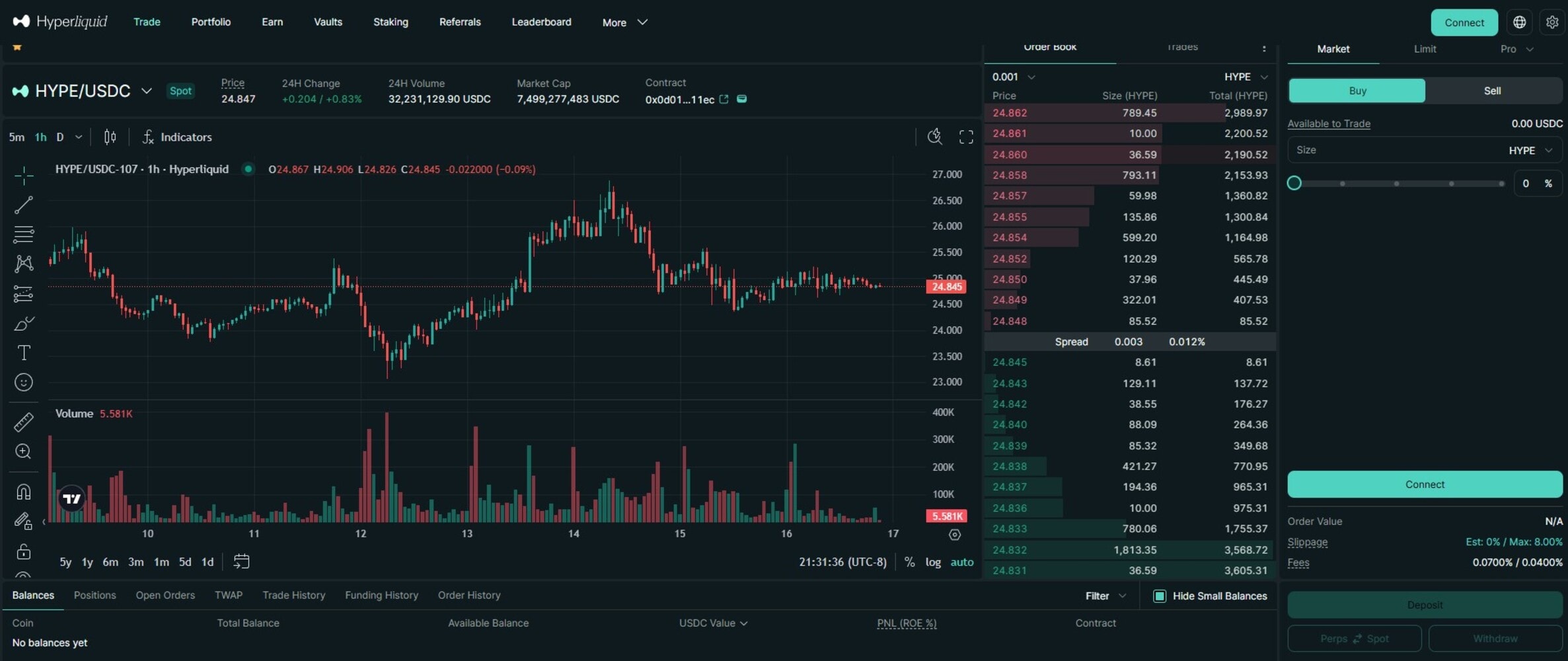
Spot trading allows users to buy and sell crypto assets directly at current market prices. It is suitable for beginners who want straightforward transactions as well as experienced traders who prefer immediate settlement. Orders are processed quickly, ensuring reliable execution and minimal price slippage during active market conditions.
Advanced Order Types
Advanced order types give traders more control over how and when trades are executed. Features such as limit orders, TWAP, and iceberg orders help manage large positions without causing sudden price movements. These tools allow users to automate parts of their trading strategy and reduce emotional decision-making.
2. Vaults and The Hyperliquidity Provider (HLP)
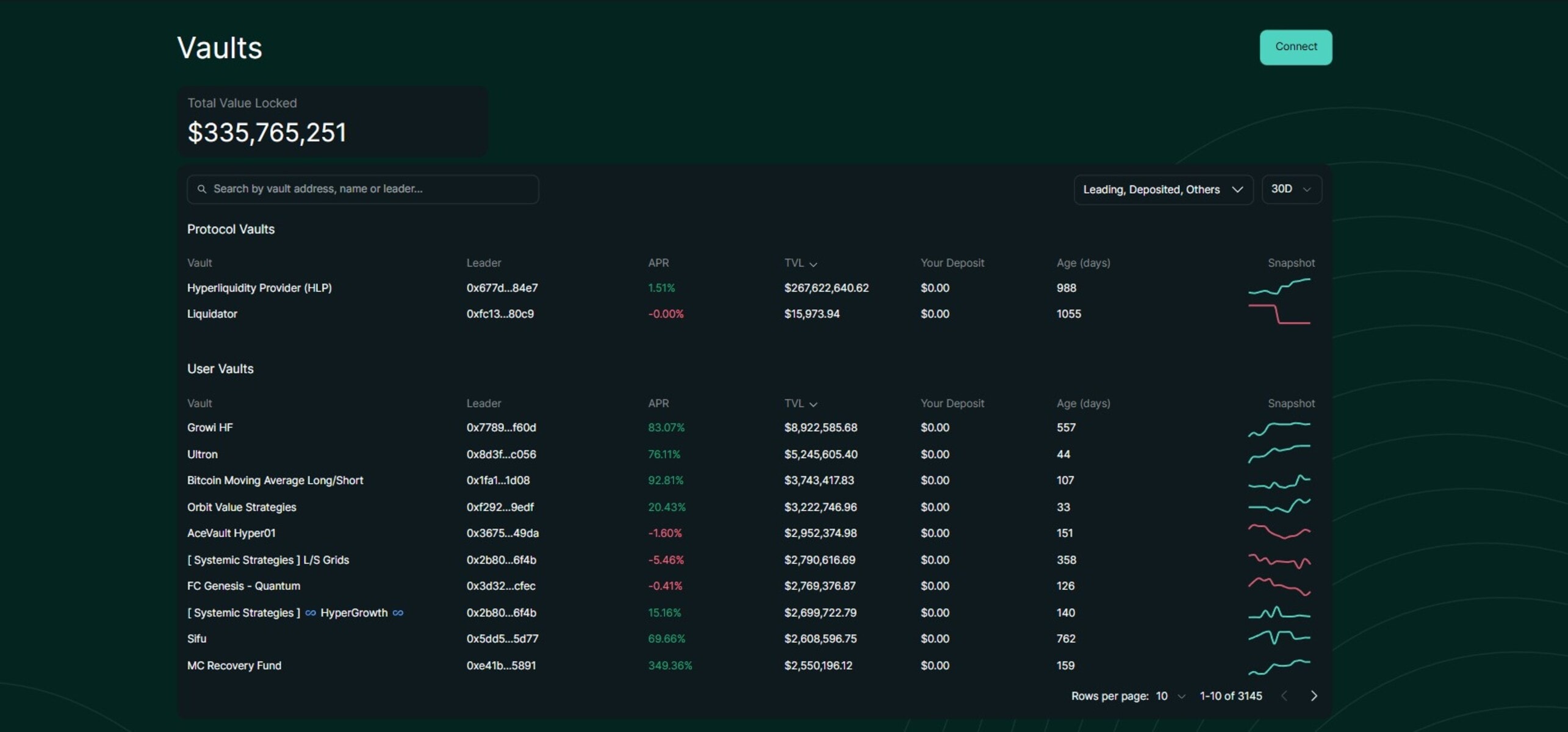
Vaults on Hyperliquid allow users to pool funds into automated strategies such as copy trading and liquidity provision. The Hyperliquidity Provider vault functions as the platform’s main market maker and liquidation engine, accepting USDC deposits without manager fees.
Funds are used to place bids and asks across perpetual markets and handle liquidations, with profits shared proportionally among depositors. With hundreds of millions in total value locked, HLP helps maintain deep liquidity and stable execution. Although withdrawals require a 4-day lockup, yields often reach 20-60% APY during volatile market conditions.
3. Hyperliquid DEX Fee Structure
Hyperliquid removes gas fees on all trades through its Layer-1 design and instead applies low maker and taker trading fees. It also runs a tiered fee structure with 0.070% for takers and 0.040% for makers, which is lower than many major decentralized exchanges.
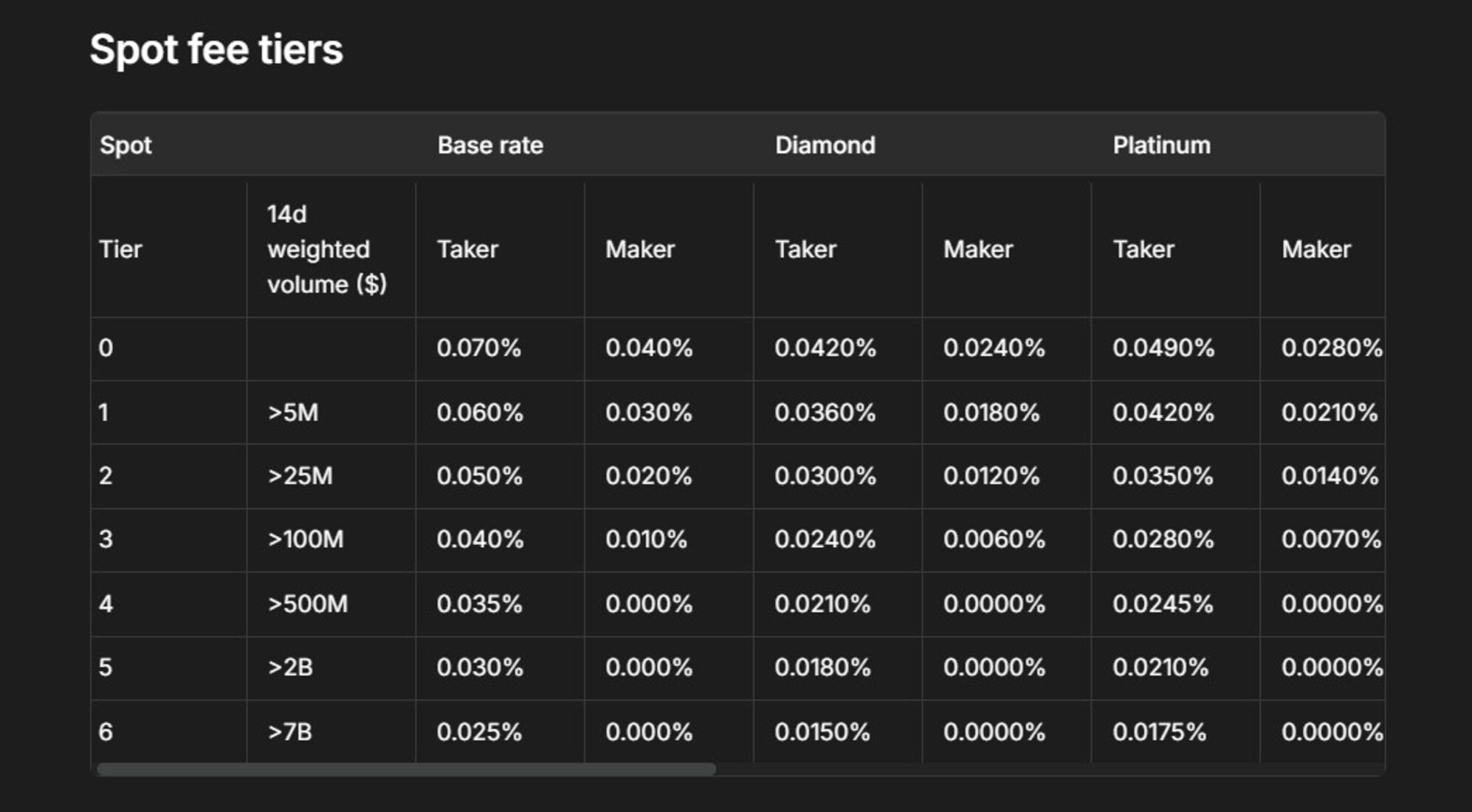
High-volume traders can further reduce costs through HYPE staking tiers, which offer fee discounts of up to 40% or 50%, while HLP depositors earn a share of taker fees.
Revenue distribution supports long-term sustainability by directing funds toward HYPE buybacks and burns, the Assistance Fund for platform protection, and rewards for stakers and liquidity providers. This allows the protocol to grow without external venture capital funding.
4. The Hyperliquid Blockchain

Hyperliquid operates on a dual-chain architecture made up of HyperCore and HyperEVM, each designed for specific network functions. HyperCore handles high-speed trading activities such as margin management, liquidations, and order execution, while HyperEVM supports decentralized applications and smart contracts.
To understand the underlying technology powering these chains, you can learn more about what a blockchain is. The network uses the HyperBFT consensus mechanism to achieve block times as low as 0.07 seconds and high transaction throughput.
More than 50 validators secure the network through HYPE staking, enabling fast finality and protecting transaction integrity. Since validators could be malicious or offline, Hyperliquid integrates Byzantine Fault Tolerance (BFT) via its custom HyperBFT consensus algorithm, which secures the entire Layer 1 blockchain against malicious or failed validators.
How Does Hyperliquid Offer Such Fast Speeds?
Hyperliquid achieves high-speed performance by combining a purpose-built Layer-1 blockchain with an optimized trading engine. The HyperBFT consensus mechanism enables transactions to reach finality within seconds through a leader-based validation process and rapid block confirmation rounds. Trading operations are handled directly on HyperCore, eliminating external dependencies and reducing network congestion.
What Are the Drawbacks of Hyperliquid?
While Hyperliquid offers speed and advanced features, it also comes with certain limitations.
- The platform’s complexity may be challenging for beginners, especially those unfamiliar with perpetual futures trading or advanced order types.
- Liquidity is high for popular pairs, but smaller or niche assets may experience higher spreads or slippage.
- The validator-based HyperBFT system relies on staked HYPE, so downtime or misbehavior by validators, although rare, could impact performance.
- Staking and vault strategies carry risks, including impermanent loss and reduced flexibility during lock-up periods. Users must carefully understand these factors before participating fully in the ecosystem.
How to Use Hyperliquid Exchange (Step-by-Step)
Step 1: Connect Wallet: Visit the official Hyperliquid website and connect a supported wallet, such as OKX Wallet, Coinbase Wallet, or log in with an email address. Ensure the wallet is funded with HYPE or USDC for trading.
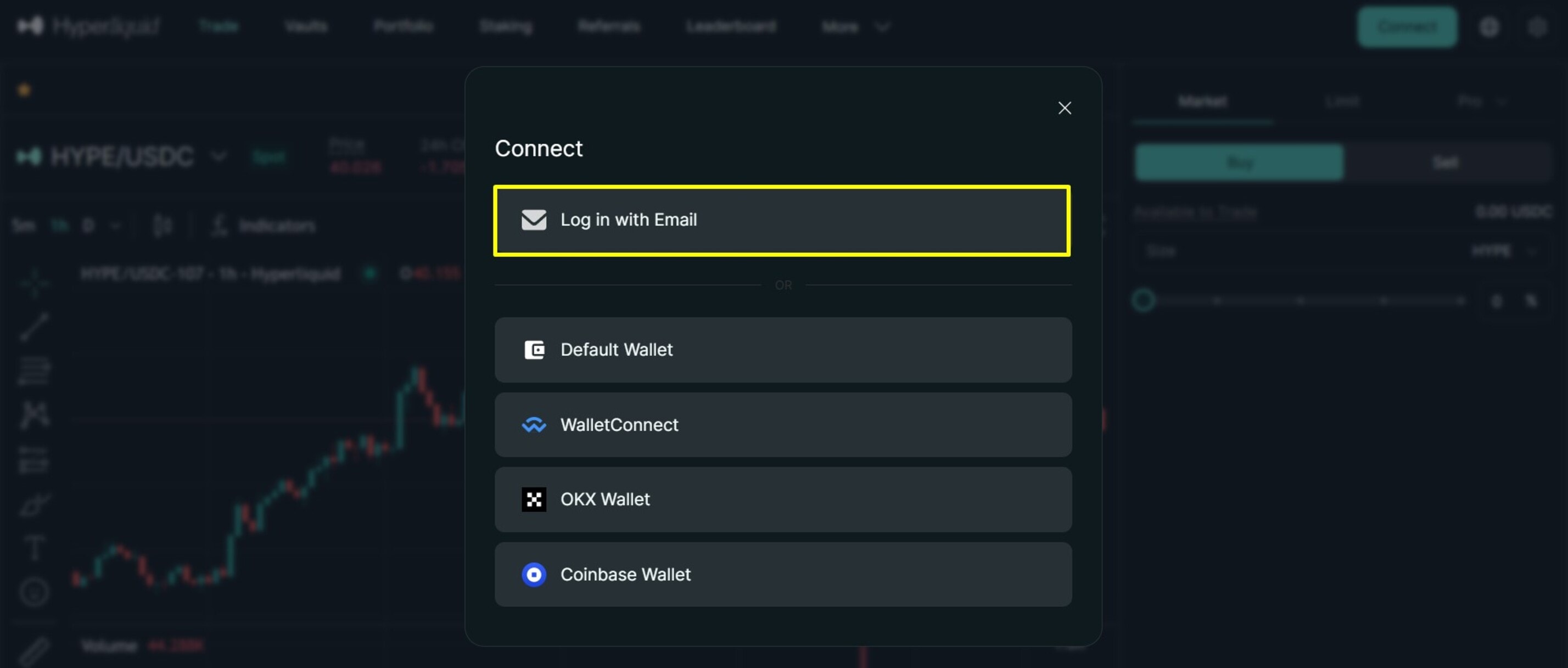
Step 2: Deposit Funds: Transfer HYPE, USDC, or other supported assets into your Hyperliquid account. Deposits are fully on-chain, enabling immediate trading or staking.
Step 3: Start Trading or Staking: Choose between spot, perpetual futures, or depositing into vaults like HLP. Each option offers different risk and reward profiles.
Step 4: Manage Positions: Monitor trades, staking rewards, or vault performance using the dashboard. Withdrawals are subject to the platform’s rules, including the HLP four-day lockup.
Hyperliquid vs Other Perpetual DEXs
| Feature | Hyperliquid | GMX | dYdX | Aevo |
| Layer | L1 (HyperCore Orderbook) | L2 (Arbitrum/Avalanche AMM) | L1 (Cosmos Orderbook) | L2 (Optimism Orderbook) |
| Order Types | Perps and spot | Perps and Spot | Perps, Advanced Pro | Perps, Options, Advanced |
| Fees (Maker/Taker) | 0.04% / 0.070% (zero gas fee) | 0.05% / 0.07% + gas | 0.02% / 0.05% + gas | 0.02% / 0.05% + gas |
| Supported Cryptocurrencies | 130+ | 40+ majors | 200+ | 100+ |
| Liquidity Model | HLP Vaults (on-chain) | GLP Pools | Orderbook/Custodial | Pre-Market Liquidity |
| TVL/30d Volume | $2.5B / $150B+ | $500M / $5B | $400M / $12B | $300M / $3B |
| Staking Rewards | 2–60% APY (HYPE/HLP) | GLP ~10–30% | Not available | 15% |
| Why it stands out | CEX-speed, no MEV, sub-second execution | Zero price impact | Deep orderbook | Options integration |
The Future of Hyperliquid
The Hyperliquid Crypto Exchange aims to become a leading decentralized finance (DeFi) derivatives platform in 2026. Some significant advancements and milestones include the full integration of HyperCore and HyperEVM, enabling dApps to run at exchange-level speeds while remaining EVM-compatible.
The platform plans to deploy a $1B treasury fund to buy and stake HYPE, aligning protocol reserves with token demand to stabilize the market and counteract volatility. Large-scale buybacks could tighten supply, especially given that 97% of protocol fees have already been allocated to HYPE repurchases.
Looking ahead to 2026–2027, HyperEVM is expected to grow with new projects, including liquid staking via kinetiq xyz and money markets through hyperlendx. Permissionless perpetuals launched under HIP-3 in October 2025 will further decentralize listings, expanding use cases for staking, lending, and derivatives trading.
Conclusion
Unlike traditional DeFi platforms, Hyperliquid combines speed, advanced trading tools, and a unique token ecosystem to create a professional-grade decentralized exchange. Its dual-chain design, HyperBFT consensus, and innovative vault system offer both retail and institutional traders ways to maximize returns while maintaining security.
While some risks exist, including validator downtime and lockup periods, HYPE staking and HLP vaults provide strong incentives for participation. But that’s not all. We reviewed the platform and compiled a comprehensive Hyperliquid review to provide insight into its features, security, and architecture.
FAQs
Yes. Hyperliquid is designed with a validator-based HyperBFT consensus and staked HYPE as economic security, providing strong protection against malicious activity. However, risks exist, such as validator downtime or vault impermanent loss, but these are rare and mitigated by network design.
Hyperliquid runs on HyperCore, a trading-optimized Layer-1, and HyperEVM, an EVM-compatible Layer-1 for decentralized apps. This dual architecture ensures fast, low-latency trading and full on-chain transparency.
Yes. Hyperliquid allows users to trade without KYC.
The platform achieves sub-second trade execution and finality, with block times as low as 0.07 seconds and throughput of over 200,000 transactions per second.
A perpetual exchange lets users trade futures contracts that never expire, offering leverage and the ability to go long or short on assets without settlement deadlines.
