37
Key Takeaways
- Satoshi Nakamoto’s 2010 emails to Malmi confirm a $3,500 cash donation was received and allocated to fund Bitcoin’s early web infrastructure.
- Researcher Sergio Demian Lerner’s Patoshi analysis links roughly 1 million BTC to an early miner whose coins remain unspent in 2026.
- Satoshi handed server and press responsibilities to Gavin Andresen in late 2010 before sending his final known email in April 2011.
Researchers have combed through white paper PDF metadata, source code commits, private emails, forum archives, and blockchain data to build a picture of Bitcoin’s creator that goes well beyond the basics. What follows are 25 of the most obscure verified findings, drawn from stylometric studies, developer correspondence, and onchain forensics.
The Metadata Trail
- Research suggests that the Bitcoin white paper PDF was created with OpenOffice.org 2.4. Document properties in both the October 2008 draft and the March 2009 published version list the Creator as “Writer” and Producer as “OpenOffice.org 2.4,” a detail rarely cited in mainstream accounts.
- The October 2008 draft PDF carries an anomalous timezone offset. The CreationDate timestamp reads 20081003134958-07’00’ (Mountain Standard Time), but October 3, 2008, fell during Daylight Saving Time, when Mountain Time should read -06’00’. Researchers have attributed the mismatch to a possible clock misconfiguration, an OpenOffice bug, or deliberate obfuscation.
- Later source code commits used British Summer Time offsets. SVN commits from late 2009 and 2010 show +0100 (winter) and +0000 (summer), consistent with the UK, contrasting with the earlier US Mountain Time signal in the PDF.
Code Fingerprints
- The original C++ source code reportedly used Hungarian notation for variable naming, including prefixes like psz (pointer to string) in files such as base58.h. That convention was largely outdated among developers by 2008 and pointed toward Windows C++ programming habits from an earlier era.
- Early pre-alpha drafts proposed a block reward of 10,000 BTC, not 50. One 2008 draft also used only four decimal places for satoshis (vs. eight) and different total supply mechanics. All of these parameters changed before the public v0.1 release.
- The word “ blockchain” does not appear anywhere in Satoshi’s original writings. The white paper and early communications consistently use “chain of blocks” or “block chain.” The single compound word only entered common use around 2014 to 2016.
- Satoshi chose JSON-RPC over XML-RPC for the Bitcoin API specifically because the available C++ XML-RPC libraries were buggy or carried problematic dependencies. He noted as much in a 2010 email to developer Martti Malmi.
- Satoshi used MinGW as his primary Windows compiler, reserving Visual C++ only for debugging purposes.
Email and Forum Behavior
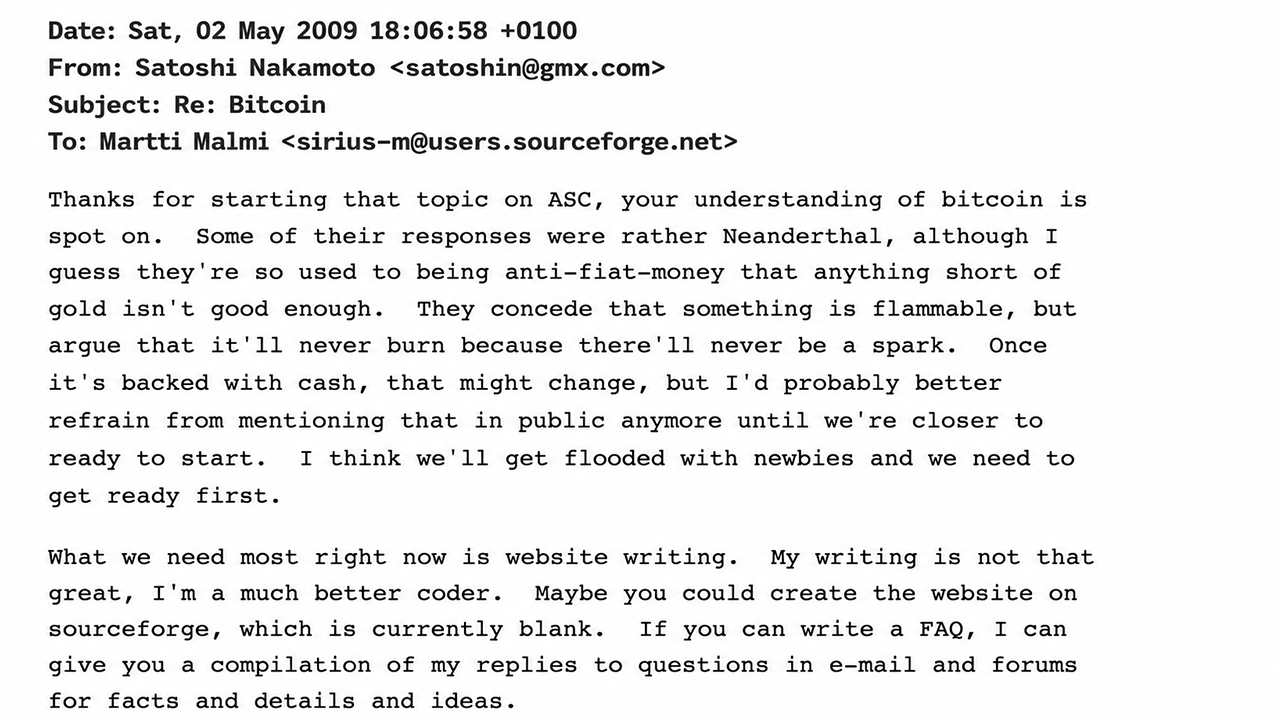
- Satoshi told Martti Malmi in May 2009 that writing was his weak spot. His exact words: “My writing is not that great, I’m a much better coder.” He recruited Malmi to help with website copy from the beginning.
- Satoshi was deeply SEO-aware and personally orchestrated a careful transition of bitcoin.org to protect its Google PageRank. Sirius emails from 2010 show him laying out a multi-step plan to change the site’s IP address and content separately so search engines would not treat it as a new site.
- Sirius emails also show that Satoshi coordinated a $3,500 cash donation sent by mail to Malmi in Finland. He later directed $1,000 of that sum specifically to back Malmi’s bitcoin exchange service.
- Satoshi issued a public network-wide alert on August 15, 2010, about a critical vulnerability. His warning to the bitcoin-list mailing list read: “DO NOT TRUST ANY TRANSACTIONS THAT HAPPENED AFTER 15.08.2010 17:05 UTC (block 74638) until the issue is resolved.”
- Satoshi went offline for roughly six weeks in spring 2010 without checking email. He acknowledged the gap in a May 2010 message: “I’ve also been busy with other things for the last month and a half. I just now downloaded my e-mail since the beginning of April,” he told Malmi.
- Satoshi personally edited the bitcoin.org SMF forum PHP source code, configured CSS, installed mods via SSH, and set up DNS entries for forum. bitcoin.org.
- Satoshi confirmed to Malmi that the Bitcoin white paper was published in 2008, not 2009, in a January 2011 email, noting that Wikipedia had the date wrong at the time.
Identity and Anonymity
- Satoshi’s P2P Foundation profile listed a birthdate of April 5, 1975, and Japan as his residence. To many speculators, April 5 references the 1933 US Executive Order 6102 that banned private gold ownership, so the date is widely interpreted as deliberate symbolism.
- Satoshi used a forum date format of DD/MM/YYYY throughout his communications, a convention common in Britain and Commonwealth countries rather than the United States.
- A manual review of Satoshi’s writings found 108 instances of US/UK spelling variants: 52 American English, 35 British English, and 21 outright misspellings, contradicting the common narrative of consistent British English usage.
- Satoshi exclusively used the single-word form “cannot” across roughly 15 documented instances. The two-word variant “can not” does not appear in any of his known writings.
- Satoshi’s writing showed double-spacing after periods at a rate of roughly 81 to 86 percent, an older typing habit flagged as a distinctive marker in multiple stylometric analyses.
Project Decisions and Handover
- Satoshi deliberately chose to de-emphasize Bitcoin’s anonymity in public messaging, directing Malmi to replace “anonymous” with “pseudonymous” guidance. His reasoning: “Anonymous sounds a bit shady.”
- Satoshi warned against calling bitcoin ( BTC) an “investment” in any official materials. In a 2009 email, he told Malmi to remove a bullet point that described bitcoin as something people should “consider… an investment,” calling it legally dangerous.
- Satoshi ran local stress tests on Bitcoin’s code before pushing updates to the network, including one that “continuously generates a lot of activity and DB access.”
- Satoshi selected Gavin Andresen, not Malmi, as the person he trusted to take over primary server administration and press relations. He wrote in December 2010: “It should be Gavin. I trust him, he’s responsible, professional, and technically much more linux capable than me.”
- Researcher Sergio Demian Lerner identified what he called the “Patoshi” mining pattern, a distinctive ExtraNonce fingerprint spanning early coinbase transactions from block 1 onward. The entity linked to that pattern is estimated to have mined roughly 1 to 1.1 million BTC in 2009 and 2010. As of June 2026, none of those coins have moved.
