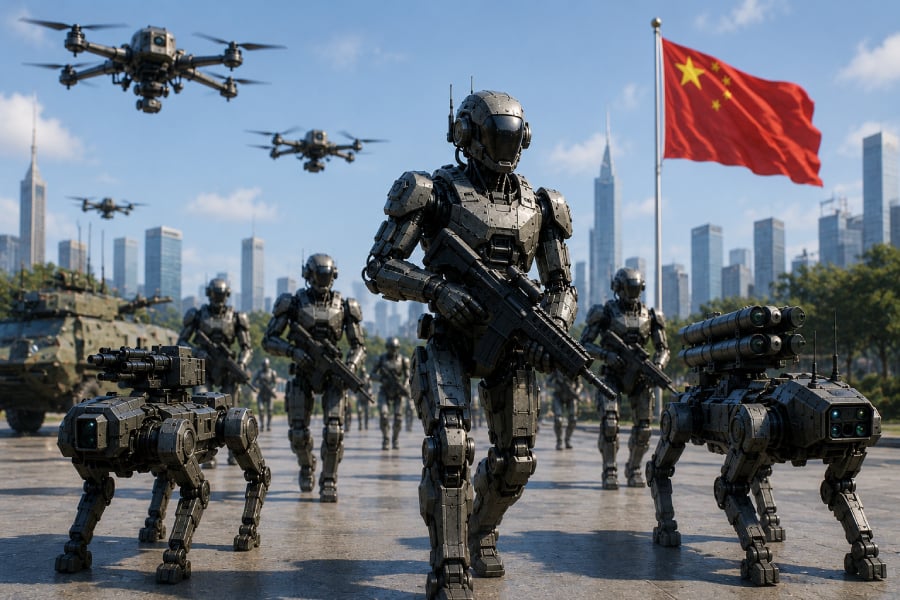
China’s humanoid robots have gone from dancing for crowds to training for a far more serious job: fighting alongside soldiers.
The shift became clearer after China’s World Humanoid Robot Games last month, where robots ran, boxed and danced. Two days later, the People’s Liberation Army’s official newspaper, PLA Daily, urged researchers to speed up the transfer of advanced technology from laboratories to military training grounds for robotic “combatants,” Reuters reported.
A Reuters review of more than 100 Chinese military procurement notices, academic studies, patents, government records and defense-industry documents found that the PLA has been exploring military applications for humanoids, particularly since 2025.
The focus goes beyond building better robots. Chinese military institutions are working on perception, physical manipulation and training data — technologies needed for machines to function outside carefully controlled demonstrations.
China’s huge commercial robotics industry could give the effort a significant boost. Chinese manufacturers accounted for about 95% of global humanoid shipments in 2025, according to Bank of America research cited by Reuters.
Built for dangerous places
Urban environments are emerging as one of the clearest military use cases in Chinese research.
A 2025 study by researchers at the National University of Defense Technology modeled six “combat robots” working with troops to clear an enemy-held building floor by floor. The group could include humanoids, robot dogs or unmanned ground vehicles.
Other military exercises have simulated robots infiltrating behind enemy lines, mapping areas and finding targets. A June 2026 procurement also set aside about $300,000 for collecting and labeling camera, radar and movement data for humanoid systems.
The attraction is straightforward: humanoids could eventually enter places that are dangerous for people while using equipment and spaces designed for humans. Dennis Hong, a professor at UCLA, told Reuters, “If losing a robot means avoiding the loss of a human life, then the robot can become expendable.”
But that advantage comes with a major limitation. Humanoids remain energy-hungry and unreliable in unpredictable environments. For simpler reconnaissance and logistics jobs, quadruped, tracked or wheeled robots may be cheaper and easier to deploy at scale, researchers told Reuters.
China’s next step: human-controlled robots
China’s defense industry is also joining the effort. Norinco, a state-owned defense company, has developed the Fuxi humanoid, which its materials describe as suitable for sentry duty, reconnaissance, patrols and dangerous missions.
Fuxi can be remotely operated, allowing a person to control the robot instead of leaving every decision to onboard software.
That approach could prove more realistic than immediately pursuing fully autonomous combat machines. It also leaves open a difficult question: how much control should humans retain when robots are eventually given weapons?
PLA commentary has discussed moving humanoids “from supporting combat toward primary combat,” including situations in which a human could verify a target before a robot fires.
The real race is not just about robots
The more important development may be the infrastructure behind the machines.
China’s procurement activity suggests the military understands that a capable humanoid needs more than strong legs and dexterous hands. It needs vast amounts of sensor data, reliable perception and systems that can translate what it sees into physical action.
That makes China’s manufacturing lead potentially more important than any single robot model. If costs fall and mass production improves, the military could draw from a much larger industrial ecosystem.
The U.S. is pursuing similar military humanoid technology, but China’s commercial lead gives Beijing a substantial base from which to experiment. For now, no evidence shows armed humanoids in operational PLA units. Malcolm Davis of the Australian Strategic Policy Institute told Reuters, “But in five to 10 years,” they could very well be practical.
Other news: Nearly half of Singapore employers now rank AI as a 2027 workforce priority, even as 71.5% of surveyed establishments have yet to begin adopting the technology.
