Key Takeaways
- SpaceX closed below $120 after seven consecutive declines, extending its loss from the $135 IPO price.
- Kimi K3’s strong reception reinforces concerns that Chinese developers can deliver competitive AI models at substantially lower prices.
- Upcoming SpaceX earnings, Starship testing and post-IPO share unlocks could determine whether the decline stabilizes or deepens.
SpaceX Decline Tests Confidence in Premium AI Valuations
Uncertainty surrounding AI-linked equities has intensified as investors weigh a temporary valuation reset against a broader unwinding of speculative enthusiasm. Recent weakness in SpaceX shares and intensifying competition from China’s AI sector have sharpened that debate.
Economist and longtime bitcoin skeptic Peter Schiff argued that the recent decline in AI-linked stocks reflects more than a temporary pullback. He pointed to SpaceX’s drop below its IPO price and the emergence of Moonshot AI’s low-cost Kimi K3 model as evidence that competitive pressure is exposing stretched valuations across the AI sector. “AI isn’t a bubble, but AI stocks are. The bubble has likely already popped,” Schiff wrote on X on July 20.
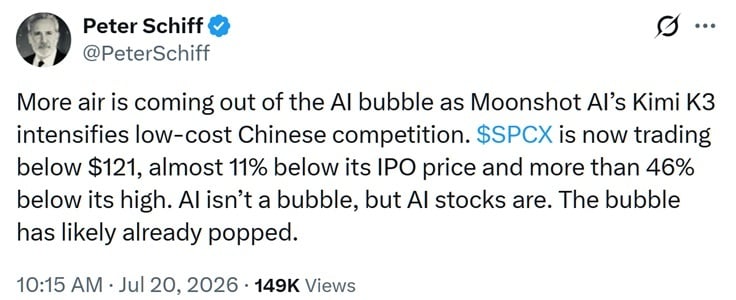
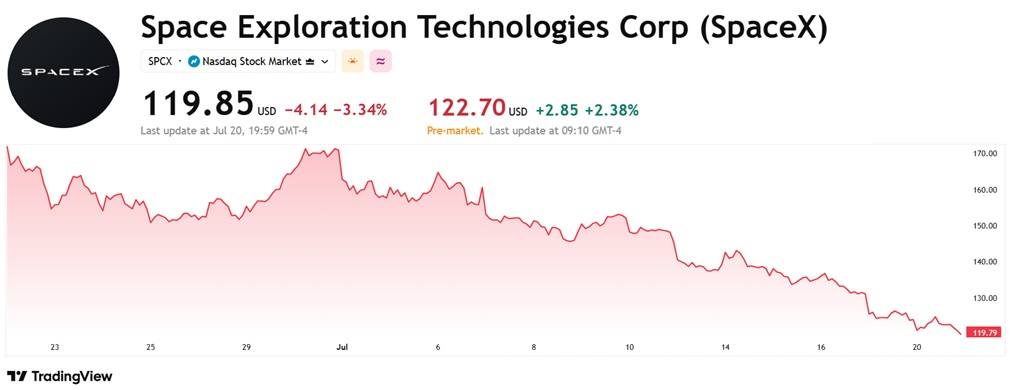
SpaceX (NASDAQ: SPCX) closed Monday near its session low after seven consecutive losing days. The stock has fallen more than 11% below its $135 IPO price and roughly 47% from its post-listing peak of $225.64, erasing more than $1 trillion in market value.
The decline, however, is not purely an AI valuation story. A postponed Starship test and a scrubbed Falcon 9 launch have increased concern about execution risks. Starship remains central to SpaceX’s satellite deployment plans and longer-term space infrastructure ambitions.
Schiff’s interpretation gains support from the speed and scale of the retreat. Yet ARK Invest purchased more than $18 million of SpaceX shares during the decline, indicating that some institutional investors view lower prices as an opportunity rather than confirmation of a permanent collapse.
Kimi K3 Raises the Cost of Defending AI Market Premiums
Moonshot AI’s Kimi K3 strengthens the pressure on U.S. AI companies by shifting competition toward performance per dollar. The open-weight Chinese model reportedly attracted enough demand for Moonshot to pause new subscriptions, suggesting that interest extends beyond promotional claims or benchmark comparisons.
Lower-cost alternatives may threaten the premium pricing and projected returns supporting large AI infrastructure investments. Academic analysis published in June concluded that genuine revenue growth and adoption support part of the sector’s valuation, while rapid capital spending, concentrated private valuations and unproven monetization create localized bubble risks.
Broader market action remains less decisive than SpaceX’s chart. Nvidia, Broadcom and AMD rebounded Monday, while the Ishares Semiconductor ETF rose 1.3%, suggesting investors had not abandoned the broader AI chip trade.
SpaceX’s next Starship attempt, expected earnings report, and subsequent lockup expiration may show whether its decline reflects company-specific pressure or a deeper reassessment of AI-related valuations.
