
Bitcoin price has fallen below $80,000 following the Federal Reserve’s decision to hold interest rates steady, even as U.S. spot Bitcoin ETFs attracted more than $423 million over three consecutive trading sessions.
Summary
- Bitcoin price fell 1.50% to $79,810.94 following the Fed’s October 28 interest-rate decision.
- Spot Bitcoin ETFs attracted $423.66 million across three consecutive sessions, according to SoSoValue data.
- The Federal Reserve maintained rates at 3.75%–4%, with two officials supporting another increase.
- Santiment found Bitcoin transaction and active-address counts below their July–September weekday averages.
- Bitcoin price faces immediate support near $79,700, while a recovery above $82,000 could improve momentum.
The Federal Reserve’s October 28 decision left its benchmark rate at 3.75%–4%, with two policymakers voting for another increase as inflation remained above the central bank’s target. Bitcoin price initially recovered above $81,000 after the announcement but subsequently retreated toward $79,800, where traders are watching for another break below support.
At $79,800 at press time, BTC was down 1.50% over 24 hours, while the cryptocurrency market had lost approximately 1.57%, as per crypto.news market data. The decline followed renewed concerns about inflation, rising oil prices and the possibility that U.S. borrowing costs could remain elevated.
Bitcoin price weakens after Fed holds interest rates
The October meeting ended with a 10–2 vote, as Federal Reserve Governor Lisa Cook and Cleveland Fed President Beth Hammack supported a quarter-percentage-point rate increase. Their opposition to the decision reflected concerns about persistent inflation despite continued economic growth.
Fed Chair Kevin Warsh acknowledged that inflation remained too high and said the central bank needed further evidence that monetary policy was restoring price stability. Responding to questions about political pressure, Warsh maintained that politics had played no role in the committee’s decision.
Investors are now awaiting September’s Personal Consumption Expenditures inflation report, scheduled for October 29. Economists surveyed by the Associated Press expected annual PCE inflation to reach 3.6%, compared with 3.4% in August.
Oil prices have complicated the outlook. Trading firm Wintermute has pointed to the inflation risks associated with Brent crude trading above $115 per barrel, particularly as higher energy costs threaten household spending and business expenses.
The Fed decision came after Bitcoin had already struggled to recover from its October decline. As crypto.news previously reported, the cryptocurrency briefly climbed above $80,000 ahead of Wednesday’s announcement as investors assessed exchange flows and geopolitical developments.
Bitcoin ETFs record three straight days of inflows
Institutional demand has provided a different picture from Bitcoin’s latest price movement, with U.S. spot ETFs reporting positive net flows throughout the first three trading sessions of the week.
SoSoValue data showed inflows of $110.34 million on October 26, followed by $175.99 million on October 27 and $137.33 million on October 28. Combined, the funds attracted $423.66 million, reversing part of the withdrawals recorded during the preceding week.
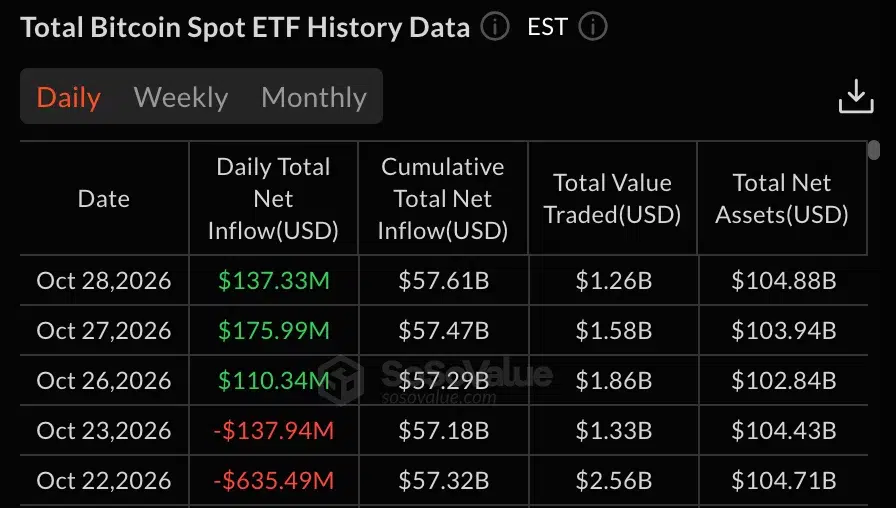
By October 28, cumulative net inflows had reached $57.61 billion, while the funds held approximately $104.88 billion in net assets. The latest session recorded $1.26 billion in trading volume.
Earlier selling had left Bitcoin vulnerable despite the recovery in fund demand. On October 22, spot ETFs lost approximately $635.6 million, followed by further withdrawals the next day. The subsequent return of institutional inflows has therefore occurred while spot-market demand remains uncertain.
ETF inflows measure net subscriptions to investment funds, meaning they do not necessarily translate into an immediate or proportionate rise in Bitcoin’s market price.
Bitcoin price prediction: $80,000 remains the key level
Selling pressure has reached the derivatives market, where more than $69 million in Bitcoin positions were reportedly liquidated over the past 24 hours, with long positions accounting for most of the losses.
On TradingView’s daily chart, Bitcoin briefly fell to $79,710 before recovering toward $80,022. The relative strength index stood at 42.25, below its moving average of 46.71, while the MACD remained negative at -497.07.
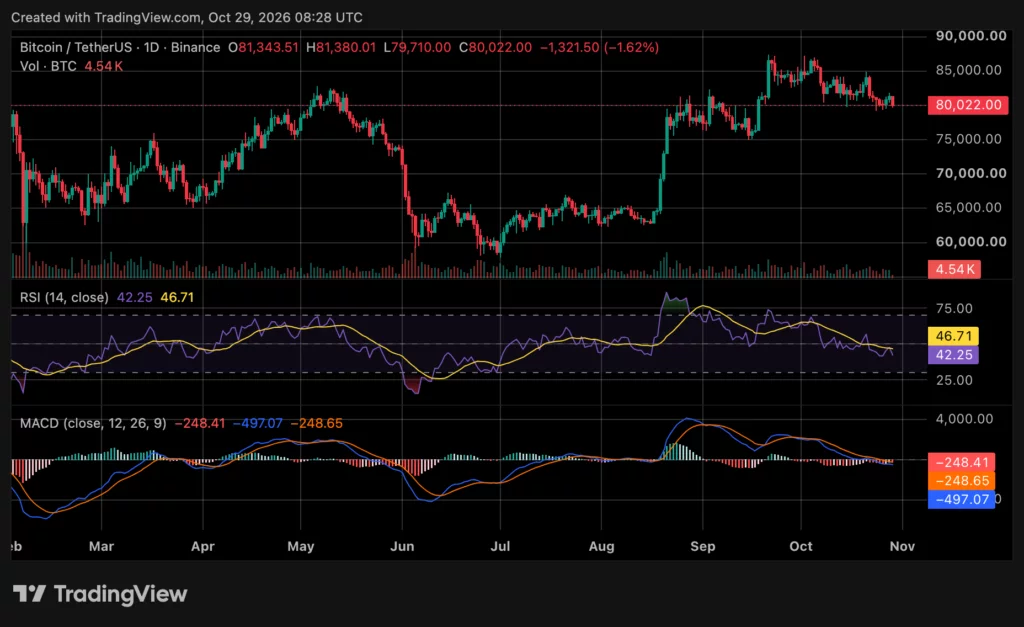
Crypto analyst Daan Crypto Trades described repeated failures to sustain local rebounds around $80,000, pointing to a short-term downward trend that has persisted since September 20.
Another analyst, Crypto Patel, identified sell-side liquidity near $74,911 and a potential lower support area between $62,000 and $69,000. His assessment remains conditional on a deeper decline.
Immediate support stands near 79,700–80,000, with a breakdown potentially exposing $78,000 and then 75,000–76,000. Buyers would need to reclaim $82,000 before challenging resistance around 84,000–85,000.
Bitcoin network activity shows little growth
On-chain analytics firm Santiment has questioned claims that Bitcoin transaction activity is accelerating. Its October 28 analysis found weekday transactions averaging 271,800 between October 14 and 27, compared with 278,800 from July through September.
Weekday active addresses averaged 637,000 during the recent two-week period, below the summer average of 662,000. Santiment noted that early October recorded approximately 295,500 weekday transactions before activity returned toward previous levels.
Separately, market analysts tracked the October 29 inflation release and major technology company earnings as near-term events affecting risk appetite. The Federal Reserve’s next scheduled policy meeting takes place December 8–9, with minutes from its October meeting due November 18.
Disclosure: This article does not represent investment advice. The content and materials featured on this page are for educational purposes only.
